

Diplomacy, n. is the art of letting somebody else have your way.
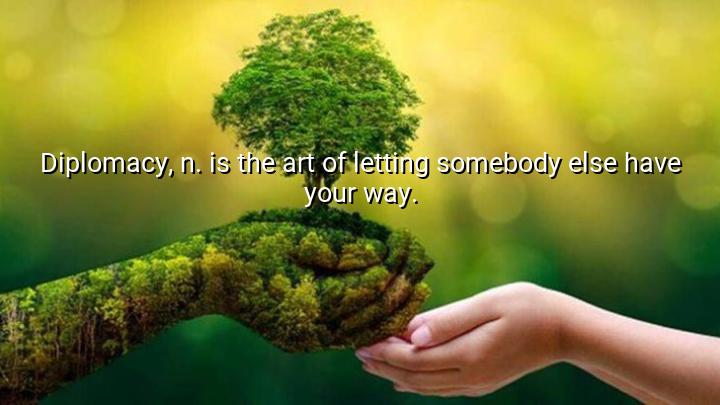




The quote "Diplomacy, n. is the art of letting somebody else have your way" by David Frost offers a satirical take on the concept of diplomacy. Frost, a renowned British television host and political interviewer, often used wit and humor to comment on serious subjects. In this quote, he suggests that diplomacy, which is typically seen as the art of negotiation and conflict resolution, is actually about subtly persuading others to adopt your perspective without appearing to force it upon them.
The word "art" in this context is used ironically, implying that the true skill of diplomacy lies not in directly imposing your will, but in maneuvering situations so that others feel they are making the decision themselves. This often involves carefully listening, understanding others' positions, and finding ways to guide them toward a solution that aligns with your own interests, all while maintaining positive relationships.
Frost's quote also highlights the power dynamics at play in diplomatic relations. It reflects the idea that sometimes the most effective form of negotiation involves making the other party feel that they are in control, even while they are unknowingly fulfilling your goals. This manipulation of perception is what makes diplomacy an intricate art—one that requires patience, strategy, and tact.
In essence, Frost's quote humorously critiques the traditional view of diplomacy as a straightforward exchange of ideas. Instead, it presents diplomacy as a subtle and often indirect art, where success is measured by how well one can achieve their objectives while allowing others to think they have prevailed.

LNLinh Nguyen
This quote made me laugh, but also think seriously about power dynamics. It implies that the most successful people are those who can make others think it was their idea all along. That’s a skill, no doubt—but is it fair? In a world that values consent and mutual decision-making, does this definition of diplomacy undermine that? Or is it just a realistic portrayal of how influence works?
TTruong
There’s something almost Machiavellian about this perspective. It makes me question how often leaders use diplomacy to conceal their real intentions. Can diplomacy truly be transparent, or is the essence of it inherently tied to strategy and subtle coercion? I’m curious how this view plays out in personal relationships too—do people 'diplomatically' manage partners or friends into doing what they want without realizing it?
NNHa Nhat Nguyen
This definition of diplomacy is clever, but I’m torn. It suggests a kind of passive control, where you steer outcomes without resistance. Is that a skill we should admire or be wary of? It almost feels like emotional judo. I wonder if this is why some people find diplomats untrustworthy—even though they're supposedly solving problems. Does effective diplomacy always come with a hidden agenda?
VGVanh Gg
I appreciate the humor in this quote—it captures the sly brilliance of true diplomacy. But it raises an interesting question: can diplomacy exist without some degree of ego or control? If you’re always aiming to have your way, even through charm or subtle influence, is that still collaboration? I’d love to hear examples where diplomacy led to mutual benefit rather than one party quietly dominating the other.
HHuy
This quote is witty, but it also makes me wonder about the ethical boundaries of diplomacy. Is it really just manipulation dressed up in polite language? Or is there genuine compromise involved? I find the idea amusing, yet slightly unsettling, especially when applied to politics or international relations. How can we distinguish between clever negotiation and deceptive tactics when the outcomes might look the same from the outside?