

Blue thou art, intensely blue; Flower, whence came thy dazzling hue?
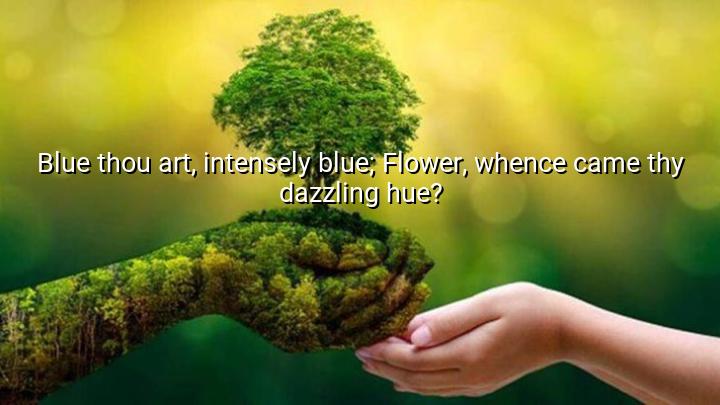




James Montgomery’s quote, "Blue thou art, intensely blue; Flower, whence came thy dazzling hue?", reflects a deep appreciation for the natural world, particularly the beauty of a flower. The speaker marvels at the intense blue of the flower, pondering the source of its stunning color. This questioning suggests an underlying curiosity about the mysteries of nature and the forces that shape its appearance. The vivid blue of the flower becomes a symbol of the wonder and awe that nature can evoke.
The phrase "whence came thy dazzling hue?" emphasizes the speaker’s fascination with the flower’s color. By asking where this dazzling hue originates, Montgomery points to the mystery behind nature’s beauty. This rhetorical question invites reflection on the complexities of the natural world and the intricate processes that produce such vibrant colors in flowers.
Montgomery, a 19th-century poet known for his reflections on nature, often explored the themes of beauty and the divine in the world around him. This quote captures his ability to find profound meaning in the simple yet captivating elements of nature. The speaker's curiosity about the flower’s color suggests a deeper philosophical inquiry about the relationship between nature, the divine, and the mysteries of life itself.
Ultimately, the quote encourages an appreciation for the wonder and mystery of the natural world. Montgomery invites the reader to marvel at the dazzling beauty of something as seemingly simple as a flower, reminding us that there is always more to discover beneath the surface of nature’s creations.

THTrung Ha
Reading this made me think about how poetry allows us to marvel at the simple things. Do you think this quote is just about a flower, or is it hinting at something larger—maybe our need to find meaning in beauty? The way Montgomery asks the flower where its color comes from feels both scientific and spiritual. What do you think he was truly seeking—knowledge, wonder, or a kind of connection?
GHDo Gia Hao
This quote makes me curious about the poetic use of color. Why is blue often associated with mystery, depth, or even melancholy? Montgomery’s question seems innocent, yet it opens up so many layers—emotionally and symbolically. Could the flower’s hue represent something beyond nature—like a longing or an unanswerable question? How much of what we perceive in nature is shaped by what we carry inside ourselves?
HNHoai Nam
The tone of awe in this quote really strikes me. It makes me reflect on how often we overlook everyday beauty, like the color of a flower. What does it say about us that a simple shade can still leave us stunned, even in an age saturated with color and visuals? Is this emotional response purely aesthetic, or does it connect to something deeper—maybe spiritual or philosophical?
TPLao Ta Phung
Montgomery’s words sound almost like a reverent question to nature itself. I find it fascinating how the poet treats a flower not just as a subject, but as something sacred or divine. Do you think this kind of poetic wonder still exists in our modern, scientific age? Or has knowing the biological explanation for color taken away some of the magic in how we view nature?
LNLinh Ngo
This line feels so rich and vivid—it captures both beauty and curiosity in such a compact form. It makes me wonder why blue, as a color in nature, feels so rare and striking. Is there something in human psychology that gives blue flowers a kind of mystical power? I’d be interested to hear how poets and scientists might answer that question differently. Where does beauty really come from: the object or the observer?