

Biodiversity can't be maintained by protecting a few species in a zoo, or by preserving greenbelts or national parks. To function properly, nature needs more room than that. It can maintain itself, however, without human expense, without zookeepers, park rangers, foresters or gene banks. All it needs is to be left alone.
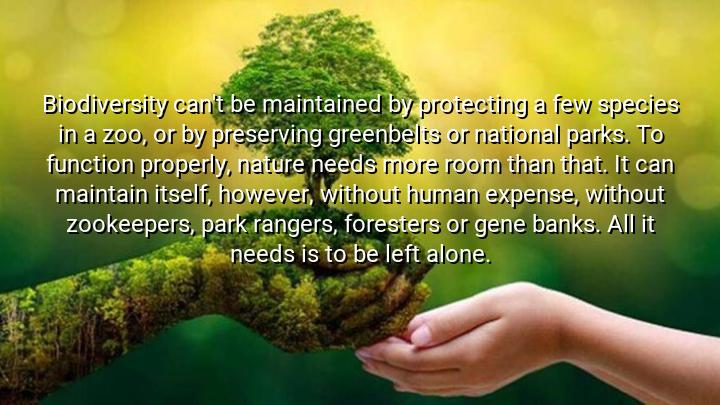




The quote "Biodiversity can't be maintained by protecting a few species in a zoo, or by preserving greenbelts or national parks. To function properly, nature needs more room than that. It can maintain itself, however, without human expense, without zookeepers, park rangers, foresters or gene banks. All it needs is to be left alone." by Donella Meadows emphasizes the importance of natural ecosystems functioning freely without human interference. Meadows, an environmental scientist, argues that while efforts like zoos, national parks, and greenbelts can help protect certain species, they are not enough to preserve biodiversity in the long term. She suggests that nature’s balance and ability to thrive depend on more than just isolated spaces; it requires vast, interconnected natural habitats where species can interact and evolve naturally.
Meadows points out that biodiversity is not a resource that can be artificially sustained by human management alone. She critiques the idea that parks and preservation areas can provide all the space and support necessary for ecosystems to function at their full capacity. Instead, she argues that nature needs expansive areas and the freedom to self-regulate without human intervention, such as zookeepers, park rangers, or gene banks. By doing so, nature can maintain itself, as it has done for millions of years before human interference.
The core message is that human efforts to control and protect nature through management strategies are limited and insufficient. Meadows advocates for a more hands-off approach, where the environment is allowed to flourish and regenerate on its own. This reflects her belief that natural processes—including species migration, ecosystem dynamics, and genetic diversity—are more effective when untouched by human activity.
Ultimately, Meadows’ words serve as a reminder that nature is inherently resilient and can thrive if left alone. Human efforts, while well-meaning, often fall short in comparison to the self-sustaining capabilities of the environment. The quote encourages a shift toward allowing nature to operate autonomously, with the understanding that true conservation comes from giving it the space and freedom to regenerate naturally.

HDLe Hoang Hai Dang
I love the blunt honesty of this quote. It strips away the romanticism around conservation and reminds us that nature is self-sustaining—if only we’d stop interfering. But it does make me wonder—are our current models of conservation more about controlling nature than preserving it? And how do we shift public and policy focus from reactive fixes to the radical idea of simply stepping back?
TPThu Phuong
Donella Meadows puts forth a powerful truth here—but it also raises a difficult question: where can we give nature the space it needs when so much of the planet is occupied, developed, or degraded? If rewilding is the answer, are we willing to make the economic and political sacrifices required to let large swaths of land go untouched? It’s a beautiful idea, but how do we implement it realistically?
QDluong quang dinh
This quote makes me think about the illusion of control. Zoos, parks, and reserves feel like symbols of conservation, but are they really just ways of preserving our own sense of involvement? Is it possible we’re protecting biodiversity more for our conscience than for nature’s benefit? If nature truly just needs space, then maybe our efforts should be more about retreat than action.
VTNguyen Viet Thanh
I find this quote both refreshing and provocative. Meadows is pushing back against the idea that human intervention is always necessary to 'save' nature. But what about invasive species, pollution, and climate change—problems we caused? Don’t we now have a responsibility to intervene where ecosystems have been destabilized? Can we draw a clear line between helpful stewardship and overmanagement, or is that distinction too idealistic?
YNYen Nhi
This quote really challenges our modern conservation mindset. Are we too focused on managing nature through confined spaces and curated ecosystems? It’s almost humbling to consider that nature doesn’t need our help—it needs our absence. But how do we reconcile that with the fact that humans have altered so much of the Earth that true wilderness is almost nonexistent? Is it even possible to truly 'leave nature alone' anymore?