

Like the other great revolutions, an environmental revolution will require sacrifices and lead to enormous gains. It, too, will change the face of the land and human institutions, hierarchies, self-definitions, cultures. It will take centuries. If it happens. There is no guarantee, of course.
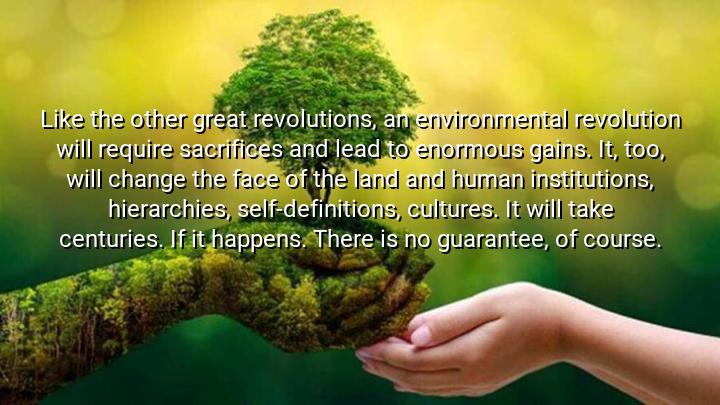




The quote "Like the other great revolutions, an environmental revolution will require sacrifices and lead to enormous gains. It, too, will change the face of the land and human institutions, hierarchies, self-definitions, cultures. It will take centuries. If it happens. There is no guarantee, of course" by Donella Meadows reflects the long-term nature of the environmental revolution that Meadows believed was necessary to address global environmental challenges. She draws a parallel between the environmental movement and other great societal revolutions, such as the industrial revolution, emphasizing that such a shift would require major sacrifices but would ultimately bring about substantial gains in the form of healthier ecosystems, more equitable societies, and new cultural and institutional frameworks.
The origin of this quote comes from Meadows' work as a systems thinker and environmental scientist. Known for her influential book The Limits to Growth, which examines the intersection of human population growth, resource depletion, and environmental degradation, Meadows was a leading voice in advocating for sustainable development and systemic change. Her quote reflects her belief that an environmental revolution is not just about solving immediate problems but about a deep and transformative process that will reshape society over the course of centuries.
Meadows acknowledges that the transformation required for an environmental revolution will not be easy or immediate. It will involve sacrifices, such as changes in lifestyle, economic systems, and consumption patterns, and it will challenge hierarchies and self-definitions that have long been entrenched in modern societies. The gains, however, could include a more sustainable and equitable world, where human activities are more in harmony with the environment. Still, Meadows is realistic in stating that there are no guarantees, and the success of such a revolution is far from assured.
In essence, Meadows is emphasizing the scale and complexity of the environmental revolution, suggesting that it is not merely a short-term or isolated change but a profound transformation in how humanity interacts with the planet. Her quote serves as a call to action, reminding us that while the task ahead is immense, it is also crucial for the future of the world, and its success hinges on both sacrifice and commitment over time.

AAdministratorAdministrator
Welcome, honored guests. Please leave a comment, we will respond soon