

You may be able to fool the voters, but not the atmosphere.
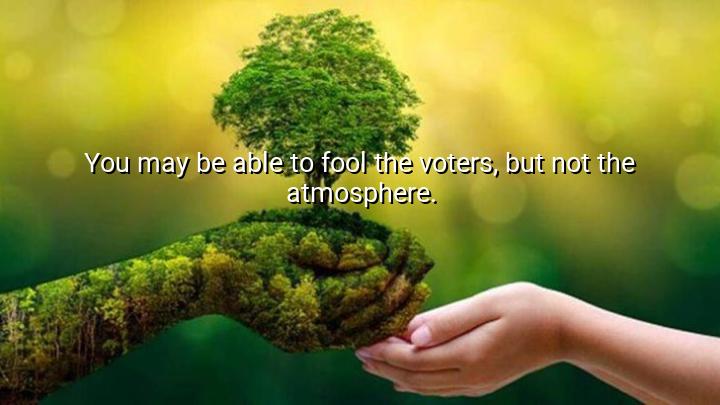




Donella Meadows' quote, "You may be able to fool the voters, but not the atmosphere," underscores the idea that while political leaders might manipulate public opinion or give the illusion of addressing critical issues, they cannot deceive the environment or the natural world. The atmosphere, representing the Earth's climate and ecological systems, operates independently of political narratives or temporary solutions. The quote suggests that no matter how convincing the rhetoric or short-term actions may be, the long-term consequences of neglecting environmental and climate issues will inevitably reveal the truth.
The origin of this quote is rooted in Meadows’ work as a systems thinker and environmental scientist. Meadows was a co-author of The Limits to Growth, which examined the unsustainable nature of modern economic and environmental practices. Her focus was on how human systems—political, economic, and social—often ignore or misunderstand the interconnectedness of natural systems. This quote highlights the disconnect between political maneuvering and the reality of environmental limits, which cannot be altered by mere public relations or policy manipulation.
Meadows' statement also speaks to the intransigence of the natural world. While human decisions may influence or shape certain outcomes, the environment operates on its own set of laws—laws that cannot be tricked or delayed indefinitely. The atmosphere and climate don’t respond to political promises or populist rhetoric; they respond to scientific principles and the reality of human impact. This serves as a warning to leaders: short-term victories or appearances will not shield us from the inevitable consequences of environmental neglect.
Ultimately, Meadows’ quote calls for honesty and integrity in addressing climate change and environmental sustainability. It warns that, unlike political promises, the atmosphere and the planet’s systems are unforgiving when it comes to human actions. The quote encourages leaders to face the reality of environmental issues head-on and make decisions based on truth, rather than trying to deceive or mislead the public about the true costs of inaction.

AAdministratorAdministrator
Welcome, honored guests. Please leave a comment, we will respond soon