

As a body everyone is single, as a soul never.
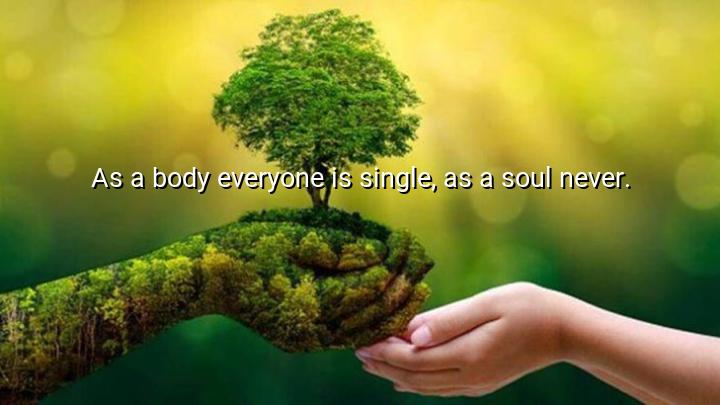




The quote "As a body everyone is single, as a soul never" by Hermann Hesse explores the distinction between our physical individuality and our spiritual interconnectedness. Hesse suggests that while each of us lives in a separate body, experiencing life as a singular being, our souls are inherently interwoven with something larger—humanity, nature, or the universe. This contrast highlights the dual reality of existence: physical separateness and spiritual unity.
Hermann Hesse, a German-Swiss novelist and poet, is well-known for his works such as Siddhartha, Steppenwolf, and The Glass Bead Game, which often explore self-discovery, spiritual growth, and inner transformation. This quote reflects his deep engagement with Eastern philosophy, mysticism, and the search for wholeness beyond the material self. He believed that our external differences are superficial compared to the shared essence within.
The idea that “everyone is single” in body refers to our individual lives, choices, and personal journeys. But when Hesse says “as a soul never,” he implies that on a deeper level, we are always connected—to others, to a universal spirit, or to a common human experience. This belief serves to both comfort and guide, reminding us that even in moments of solitude, we are never truly alone.
Ultimately, the quote invites reflection on the unity of all beings, encouraging us to move beyond our perception of separation and recognize our place in a greater spiritual wholeness. It’s a message of hope, compassion, and belonging—a reminder that while we walk our own path, we are always part of something deeper and eternal.

THLe thi Hien
There’s something comforting in this quote, but also a bit mysterious. It makes me wonder if this idea is rooted in a specific spiritual belief — maybe something like the collective unconscious, or soul reincarnation? It seems to say that beneath all individuality, we’re part of something shared. Do you think this idea can help people feel less lonely, or does it require a leap of faith to really believe it?
NAnhat anh
This quote raises a fascinating question for me: if our souls are never alone, then what exactly is the experience of emotional loneliness? Is it a mental illusion created by our ego, or is it the result of disconnection from our own soul’s depth? Maybe when we feel most alone, it’s not others we’re missing — it’s the deeper awareness of unity within ourselves.
1NNgan Lop 10_4 Ngoc
Reading this, I can’t help but think about love and empathy. Maybe part of why certain moments with others feel transcendent — even wordless ones — is because they’re glimpses of that soul-level connection. But how do we access that awareness more consistently in everyday life? Can meditation, art, or vulnerability bring us closer to that realization, or is it something that just ‘happens’ spontaneously?
TTThanh Thuy Tra Thi
This line makes me pause. Could it be that part of our suffering comes from forgetting our soul’s interconnectedness? We focus so much on our physical independence — our bodies, careers, identities — that we may miss the subtle threads linking us to others. How can we live in a way that honors both our individual boundaries and our shared spiritual essence?
PMPhuong Mihh
I love the duality in this quote — the idea that we’re singular and communal at once. But it makes me think: if our souls are never truly alone, why do we often feel such deep emotional isolation? Is it because we’ve lost touch with that inner awareness, or does modern life actively push us away from the kind of presence where we might sense this soul connection more clearly?