

Artists don't make objects. Artists make mythologies.
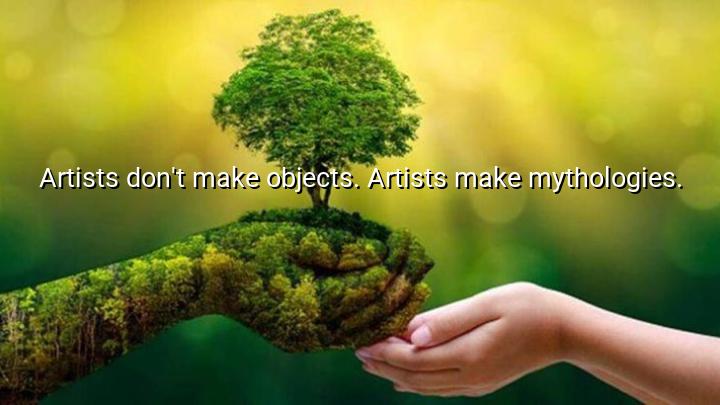




The quote " Artists don't make objects. Artists make mythologies" by Anish Kapoor reflects his view that the role of the artist goes beyond the physical creation of material objects. Kapoor, a renowned sculptor, suggests that the true power of art lies not in the objects themselves, but in the ideas, stories, and meanings that artists imbue into their work. Artists do not merely create tangible things; they create symbolic worlds, experiences, and mythologies that provoke thought, reflection, and emotional response. For Kapoor, the artwork is a conduit for something deeper and more intangible than just form and function.
Kapoor’s statement emphasizes that art is about the narrative and emotional resonance it carries. Mythologies are a collection of shared stories, symbols, and beliefs that transcend time and culture, often carrying universal truths. By saying artists make mythologies, Kapoor is highlighting the idea that their work has the power to create new symbols and meanings that shape our collective understanding and cultural identity. In this way, the artist functions not just as a creator of physical objects but as a storyteller, shaping the mythology of the present moment.
The quote also underscores Kapoor's focus on the conceptual nature of art. His works often explore themes of the void, the infinite, and the transcendent, engaging with ideas and symbolism that go beyond the material realm. For Kapoor, the object itself is secondary to the experience it creates in the viewer's mind. The work is an entry point into a larger, more abstract narrative that can be interpreted in multiple ways, much like the evolution of myths across cultures.
Ultimately, Kapoor's quote challenges the traditional notion of art as a purely material pursuit. Instead, it invites us to consider art as a way of shaping meaning and creating cultural narratives that resonate on a deeper level. Artists do not simply produce objects; they craft mythologies that reflect our shared experiences and aspirations, and through their work, they contribute to the ongoing evolution of our collective imagination.

LHLe Hoang
What I love about this quote is how it reframes the act of creation. It makes me think that when I see a sculpture or a painting, I’m not just seeing the object, but stepping into a new world with its own logic and lore. But then again, what separates a myth from a simple story? Is it the scale, the truth it points to, or how many people believe in it?
LBly bui
There's a kind of arrogance in this quote that I both admire and question. It assumes that art is always bigger than itself—that it must carry a universe of meaning. But what about minimalist or purely decorative work? Can something be meaningful without a myth? Or is the myth in the eye of the beholder? I wonder if Kapoor is drawing a line too firmly here.
UGUser Google
I’m intrigued by the implication that artists are modern-day mythmakers. Does that mean artists are inheriting a role that once belonged to religion or folklore? If so, what kinds of myths are we making today—myths of identity, technology, trauma? This quote makes me think of art as a vessel for collective memory and imagination. But then, who decides which myths endure and which fade away?
HHDau Thi Hoang Hop
Is Kapoor suggesting that the physical form of art is secondary to the story or symbolism it carries? If that's true, does the value of art lie more in interpretation than in execution? I find that a little intimidating, honestly—what if I miss the 'myth'? Can art still be appreciated at face value, or do we have to study it like literature to truly understand it?
MD45-Nguyen minh Duc
This quote really resonates with me, especially in the way it elevates the role of the artist beyond craftsmanship. But it also makes me wonder: if artists are creating mythologies, how much responsibility do they have over the narratives they build? Are they simply reflecting culture, or shaping it? I’d love to hear thoughts on whether this idea empowers artists—or burdens them with unintended influence.