

Art! Who comprehends her? With whom can one consult concerning this great goddess?
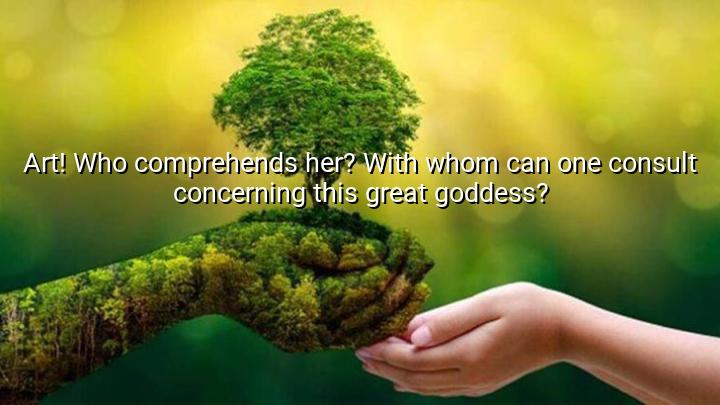




The quote "Art! Who comprehends her? With whom can one consult concerning this great goddess?" by Ludwig van Beethoven reflects the profound mystery and awe that art inspires. Beethoven, a towering figure in classical music, expresses both his reverence and the challenge of understanding art in its fullest sense. By referring to art as a "great goddess," he elevates it to a divine, almost unreachable status, implying that art is beyond human comprehension and control, and that no one can fully grasp its depths or guide another in understanding its essence.
Beethoven’s quote also suggests the complexity of art and the solitude an artist often feels in their creative process. The artist is left to engage with art on a deeply personal level, grappling with its mysteries and its ability to evoke emotions, thoughts, and ideas that cannot always be neatly explained. The question "With whom can one consult?" reflects the isolation of the artist, as art is something so inherently personal and intangible that it cannot easily be shared or fully discussed with others.
This sentiment likely stems from Beethoven's own experience as a composer and musician. Despite his genius, Beethoven faced personal struggles, including his growing deafness, which isolated him both physically and emotionally. Yet, through this personal battle, he continued to create some of the most powerful music ever composed. In this context, the quote speaks to the challenges and inner turmoil that often accompany the pursuit of art, where even the artist may not fully understand the source or depth of their creation.
Ultimately, Beethoven’s words highlight the ineffable quality of art. It is not merely a product or a technical skill, but a mysterious and transcendent force that cannot always be fully comprehended or explained. Through this reverence for art, Beethoven underscores its divine nature and the difficulty of fully capturing its essence, inviting both artists and viewers to appreciate its complexity and beauty without necessarily needing to understand it completely.

LTNgoan Ly Thanh
Beethoven seems to highlight how art cannot be easily explained or comprehended by any single person. It raises an interesting point—does this mystery of art make it more valuable or less so? Is there an inherent beauty in the ambiguity, or should we be seeking deeper explanations? Is the search for answers about art an endless journey, or should we simply accept that some things remain beyond our understanding?
DDuc
The question ‘with whom can one consult concerning this great goddess?’ really speaks to the individual and sometimes isolating experience of art. When we create or experience art, we often do it alone, trying to decode something that feels deeply personal. How much of art’s greatness lies in the fact that it can never be fully understood? Should this uncertainty make us appreciate it more, or is it frustrating not to have a clear answer?
YLBao Yen Le
Beethoven’s quote makes me reflect on the complexity of art. If art is this ‘great goddess,’ then it’s both a subject of awe and something to be explored, but never fully grasped. Does this mean that art is always subjective, with each person having their own interpretation? How do we reconcile this idea with the desire to define art with rules and standards? Is the pursuit of understanding art ever truly possible?
VTVu Theu
The way Beethoven speaks about art almost makes it seem like a mysterious, elusive force that cannot be easily captured. If art is a goddess, then is it something that is worshipped, feared, or revered? How do we approach art in a way that allows us to connect with it, if it’s beyond complete understanding? Should we embrace the mystery of art, or do we strive to find some kind of concrete meaning behind it?
TMThuy Minh
Beethoven’s reference to art as a ‘great goddess’ is fascinating because it elevates art to a divine status, something beyond comprehension or full understanding. Can art ever truly be understood, or is it something that transcends logic and reasoning? I wonder, how do we, as viewers or creators, approach something so vast and intangible? Is it enough to simply feel or experience it, or should we always seek to understand it more deeply?