

Art should be an oasis: a place or refuge from the hardness of life.
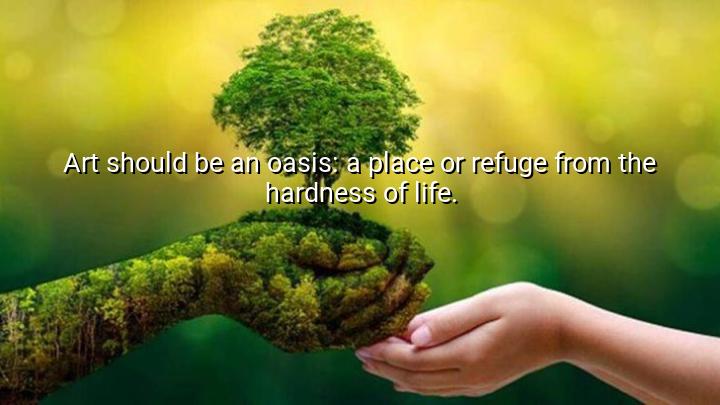




The quote " Art should be an oasis: a place or refuge from the hardness of life" by Fernando Botero speaks to the role that art plays in offering an escape from the challenges and harsh realities of everyday existence. Botero, a renowned Colombian artist famous for his signature style of exaggerated forms and figures, believes that art should provide a space where people can temporarily retreat from the difficulties and struggles of the world. Rather than simply reflecting life as it is, art should create a sanctuary that offers comfort, relief, and inspiration.
In this context, art is seen as a form of refuge—a place where individuals can find solace, emotional expression, and mental respite. Just as an oasis provides refreshment and relief in the desert, art serves as a space where one can be rejuvenated and restored, allowing for healing and introspection. Botero suggests that art should offer an alternative to the harshness and demands of modern life, allowing people to disconnect from stress and find peace.
Botero’s view reflects the broader idea that art has the power to transform our perception of reality. It is not meant to simply portray the world in its raw, unfiltered form but to provide a means of coping with its difficulties. By creating an oasis, art helps individuals navigate the complexities of life, offering beauty, meaning, and emotional refuge when the outside world becomes overwhelming.
In essence, Botero's quote highlights the restorative power of art. It serves not just as a reflection of life but as a sanctuary that helps individuals process emotions, find comfort, and escape from the stresses of daily existence. Through its ability to soothe and inspire, art becomes a vital source of emotional resilience in a world that can often feel harsh and unforgiving.

QNQuynh Nguyen
As a reader, this quote reminds me of why I turn to music, literature, and visual art when things get tough. But I’m also wondering—what makes art feel like a refuge to someone? Is it personal meaning, beauty, nostalgia, or something else? Can something abstract or challenging still be a comfort if it speaks to your inner world? I think the emotional connection might be more important than the form it takes.
TTNguyen Thi Thu Thao
This quote made me think about the role of museums and galleries. Do you think these spaces should reflect Botero's idea of refuge—peaceful, inspiring, and separate from the stress of daily life? Or should they be more interactive and confrontational, reflecting real-world issues? I’m torn, because both approaches seem valid. I’d love to know how curators navigate this balance when presenting art to the public.
GNGiang Nguyen
Reading this, I feel comforted, but also a bit skeptical. In a world full of chaos and conflict, is it realistic to expect art to be a sanctuary? Or is that an ideal that only exists in certain cultures or communities? I wonder if people living in constant instability see art the same way. It would be fascinating to hear how different societies interpret this idea of artistic refuge.
PTTran thi phuong tam
I like the sentiment here—it’s poetic and hopeful—but does it potentially limit the definition of what art can be? Some of the most powerful art I’ve experienced has been gritty, even painful, and didn’t feel like an 'oasis' at all. Yet, in hindsight, it gave me emotional clarity or strength. Maybe the 'refuge' Botero speaks of doesn’t always look peaceful—maybe it’s about emotional truth rather than comfort.
VPVy Pham
This quote brings up an interesting debate. If art is supposed to be a refuge, does that mean artists have a responsibility to create beauty and comfort? Or is it enough for them to express whatever truth they feel, even if it’s raw or disturbing? I’m torn—sometimes I want art to soothe me, but other times, I want it to challenge me. Can it be both at once?