

Art owes its origin to Nature herself... this beautiful creation, the world, supplied the first model, while the original teacher was that divine intelligence which has not only made us superior to the other animals, but like God Himself, if I may venture to say it.
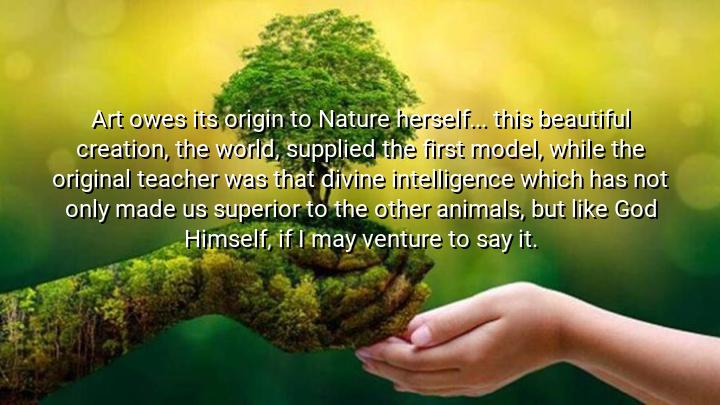




In this quote, Giorgio Vasari reflects on the deep connection between art and nature. He suggests that art owes its very origin to the natural world, which serves as the first and most influential model for artistic creation. According to Vasari, nature provides the form and inspiration for artists, who draw from the beauty and complexity of the world around them to create their own works of art. The idea is that nature itself is the starting point for all artistic endeavors, with the artist's role being to observe, interpret, and represent it.
Vasari further emphasizes the role of divine intelligence in guiding the creation of art. He attributes the ability to create and appreciate art not just to human ingenuity, but to a higher power that has endowed humanity with superiority over other animals. This divine intelligence, in his view, has allowed humans to not only imitate nature but also to surpass it in creating representations of it. In this sense, art is seen as an extension of human and divine potential, a form of expression that reflects both the beauty of nature and the intellectual and spiritual capabilities of humankind.
The phrase "like God Himself" in the quote suggests that the act of creation through art is a reflection of the divine power, placing artists in a unique position where their work mirrors the creation of the world. Vasari's statement elevates the artist to a quasi-divine role, suggesting that through their artistic endeavors, they are engaging in a process similar to the creation of the world itself. The artist’s ability to transform nature into art becomes a way of participating in the creative power of the divine.
Ultimately, Vasari’s quote underscores the profound relationship between art and nature, viewing art as both an imitation and an elevation of the natural world. It positions the artist as a creator who, inspired by divine intelligence, imitates nature and, in doing so, participates in a higher form of creation. This perspective celebrates the sacred and intellectual aspects of artistic creation, linking it to both human and divine power.

HNHoang Nguyen
This quote makes me question the source of human creativity. Is it truly divine, as Vasari implies, or is that just a romantic notion? While I admire the sentiment, I think it also opens up debate about whether creativity is a uniquely human trait or something more universal. Are we the only beings capable of art, or might nature itself be expressing artistry in its forms and patterns?
NOLuong Ngoc Oanh
Reading this, I feel a deep sense of reverence for both nature and creativity. But does this view still resonate in today's art world, which often prioritizes conceptual, political, or social commentary over aesthetics and natural inspiration? I wonder whether Vasari’s philosophy still has a place in modern art education, or if it's considered outdated by contemporary standards.
TNTuan Nguyen
I find this quote beautiful, but it also makes me wonder—if nature is the ultimate muse, how does that influence art that’s abstract or digital, removed from the natural world? Can virtual or synthetic art still be considered rooted in nature if it doesn’t mimic or reflect it directly? Or has our concept of 'nature' expanded to include the artificial environments we've created?
DT50-Pham Dinh Thanh
There’s a boldness in likening human creativity to divine intelligence. Is Vasari suggesting that the act of creating art elevates us to something godlike? That’s a powerful idea, but it also raises questions about humility. Can this mindset encourage arrogance in the creative process, or is it simply a tribute to the sacredness of artistic inspiration? I’d love to hear how others feel about the spiritual dimension of creating.
STHung Si Tray
Vasari’s quote makes me reflect on how deeply connected art is to the natural world. If nature is both the origin and the model for art, does that mean the role of the artist is less about invention and more about interpretation? I'm curious whether modern artists still view nature as their core inspiration, or has that shifted with technology and urbanization? Have we moved too far from this original teacher?