

Art is the right hand of Nature. The latter has only given us being, the former has made us men.
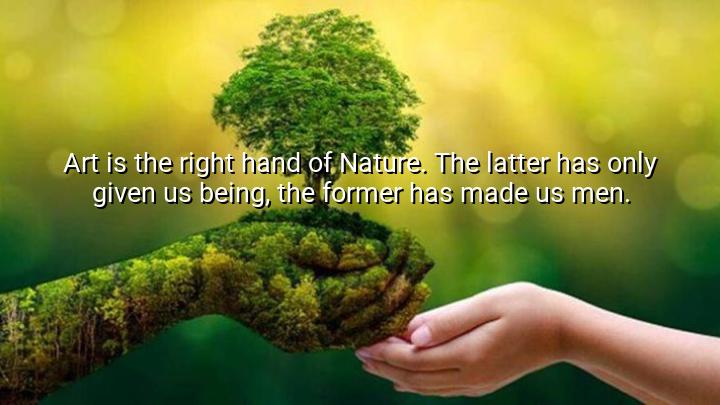




The quote "Art is the right hand of Nature. The latter has only given us being, the former has made us men" by Friedrich Schiller suggests that while Nature provides the foundation of existence, art is what elevates humanity and gives meaning to life. Schiller implies that Nature gives us life and the raw materials of the world, but it is through art that humanity truly becomes civilized, capable of expressing emotions, ideas, and ideals. In this sense, art is a transformative force that shapes human experience and development beyond mere survival or existence.
Schiller, a German poet and philosopher, often explored the relationship between nature, culture, and human flourishing. He saw art as a vital force that not only reflects the world but also shapes it, helping to define what it means to be human. For Schiller, art transcends the physical world of mere survival and materiality by cultivating the moral and intellectual aspects of human life, making us more than just beings; it makes us men, capable of understanding and creating beauty, meaning, and culture.
The origin of this quote lies in Schiller’s broader philosophy on aesthetic education and the role of art in personal and societal development. In works like On the Aesthetic Education of Man, Schiller argued that art has the power to elevate the human spirit and provide a pathway to moral and intellectual growth. He believed that art helped bridge the gap between the primal instincts of nature and the higher aspirations of human civilization.
For artists, this quote serves as a reminder that their craft plays a crucial role in shaping and refining human experience. Schiller’s words encourage artists to see art not just as a form of personal expression but as a powerful force that contributes to the cultural and moral development of humanity. It underscores the importance of art in helping us transcend our basic instincts and evolve into more thoughtful, creative, and emotionally aware individuals.

GBnguyen gia bao
As someone who’s always valued both science and art, I find this quote compelling. It suggests that art gives us purpose, identity, and meaning, not just the ability to function. But I wonder—can someone fully flourish without engaging in art at all? Or is some form of aesthetic or creative expression inevitable in any human life? It makes me want to explore how art is woven into even the most practical lives.
TLThu Thao Le
This quote seems to argue that art is responsible for our development beyond mere survival. That’s a pretty profound idea. But then, what kind of art does Schiller mean? Is it all-encompassing—music, painting, literature, theater—or is he focusing on high art in a classical sense? Depending on the answer, the implications change drastically. It could either be a deeply inclusive message or a more elitist one about cultural refinement.
TPTram Pham
There's something deeply romantic in this quote—placing art as a divine partner to nature. But I wonder if that implies that nature alone is somehow incomplete or even inadequate. Can we really say that art 'improves' on nature, or is it simply a different kind of beauty? This also makes me consider whether technology or science might be competing for that same role today. Has art lost its place as the 'right hand' in modern culture?
TTThu Thu
This feels poetic but also a bit idealized. If art is what makes us 'men,' then what about people who live without access to the arts—do they miss something essential? Or is he saying that art represents the values, ideas, and creativity that elevate human life? I’d love to know how this concept applies across different cultures. Is Schiller’s view universal or rooted in a particular time and place?
DHDuc Huy
I’m fascinated by how Schiller elevates art almost to a divine status—like a force that completes us. But I’m curious about what he means by ‘made us men.’ Is he speaking of moral development, intellectual growth, emotional depth, or all of the above? It also raises the question of whether a society without art could ever be truly civilized or emotionally whole. Is art the measure of our humanity?