

Art is the path to being spiritual.
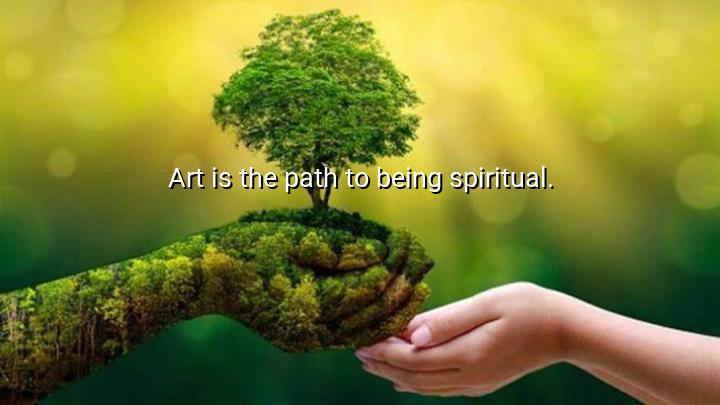




The quote " Art is the path to being spiritual" by Piet Mondrian reflects the idea that art can serve as a means of achieving a deeper, more transcendent understanding of life and existence. Mondrian, a Dutch painter best known for his work in abstract art and as a key figure in the De Stijl movement, believed that art had the power to move beyond the physical world and connect individuals to something greater—spiritual truths or universal harmony. For Mondrian, creating and experiencing art was a way of seeking and expressing the profound, non-material aspects of life.
In this quote, art is not just about aesthetics or visual expression; it is a spiritual journey that allows both the artist and the viewer to transcend the mundane and explore higher realms of understanding. Mondrian's approach to abstract art, with its focus on geometric forms and primary colors, was an attempt to strip away the distractions of the physical world and reveal a deeper, more universal order. His work aimed to reflect the spiritual essence of the universe, encouraging a connection with the fundamental principles of life.
Mondrian's view aligns with the broader concept of art as a path to spirituality, which suggests that through creative expression, individuals can tap into a deeper sense of purpose, meaning, and inner peace. For Mondrian, the reduction of form and color in his paintings was a way of reaching spiritual purity, where the work was not simply a representation of the material world but a manifestation of something more eternal and universal.
In essence, Mondrian's quote suggests that art is more than just a creative practice—it's a spiritual practice. By engaging with art, whether as an artist or an observer, one can access a deeper understanding of existence and connect with something beyond the physical, making art a pathway to spiritual awakening and enlightenment.

TSPhan thanh sang
There’s something almost defiant in this quote, like it’s rejecting traditional religious pathways in favor of something more personal and intuitive. I wonder if Mondrian saw institutional spirituality as rigid, and art as a freer, more authentic route. Does this suggest that spirituality is more about personal experience than shared belief? If so, it challenges the way society often structures spiritual life. Is that what he intended?
TZxink dep tuyt zoi
From a psychological perspective, I’m intrigued by the suggestion that art and spirituality are linked. Could it be that creating or experiencing art engages parts of the brain associated with transcendence, peace, or interconnectedness? That might explain why people feel deeply moved by certain artworks. I’d be interested to see if neuroscience supports this connection Mondrian implies. Is the spiritual effect of art something universal or culturally conditioned?
THChu Thuy Hien
Honestly, I find this quote both inspiring and frustrating. Inspiring, because it elevates art to something profound and essential—but frustrating because it feels a bit exclusive. What about people who don’t see themselves as 'artistic'? Are they left out of the spiritual journey Mondrian is talking about? Or is there an unspoken idea that creativity exists in everyone, even if it’s not expressed traditionally? I wish Mondrian elaborated more on what 'art' means here.
THThanh Hang
Mondrian’s quote makes me wonder—was his own spiritual practice tied to his painting? His later abstract works seem so structured and minimalist, almost like meditative symbols. Could the act of creating something so carefully balanced be his form of spiritual discipline? I’d love to understand whether he found transcendence in the process or in the result. How can viewers access that same spiritual space just by looking at art?
TTTran Thao
This quote really makes me think about the role of art in everyday life. If art leads to spirituality, then are we undervaluing its importance by treating it as just decoration or entertainment? Maybe that’s why so many people feel disconnected in modern times—because we’ve replaced real, intentional artistic expression with quick content and surface-level visuals. Do we need to bring back reverence for art to reconnect with something deeper in ourselves?