

Art is the only way to run away without leaving home.
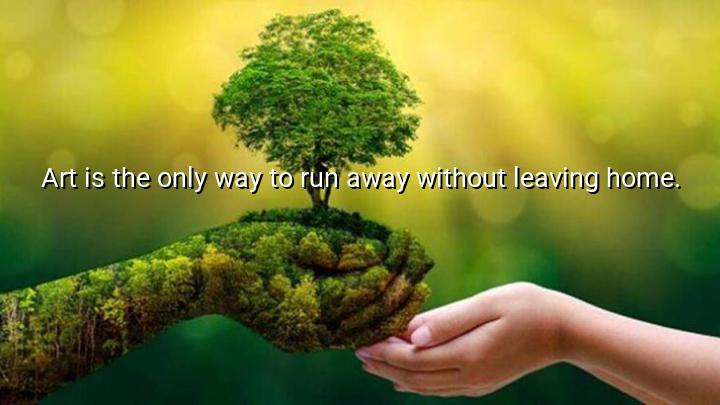




The quote "Art is the only way to run away without leaving home" by Twyla Tharp highlights the idea that art provides an escape or a form of freedom that allows individuals to explore new worlds, ideas, and emotions without physically leaving their current environment. Tharp, an acclaimed American dancer and choreographer, suggests that through creative expression, individuals can transcend their immediate surroundings and experience a mental or emotional journey that takes them beyond the ordinary, offering a sense of release and liberation.
In this context, Tharp emphasizes that art offers a safe escape—a way to venture into unfamiliar or imagined realms without physically departing from one’s location. It is an internal journey, where the imagination and creativity lead the way, enabling individuals to confront emotions, explore new identities, or process experiences without ever leaving their comfort zone or facing the constraints of the outside world.
The quote also touches upon the transformative power of art, where a painting, a piece of music, a dance, or a poem can take an individual to a different time, place, or state of mind. Art acts as a portal, offering experiences that are more profound than mere physical travel, as it allows for emotional and intellectual exploration that enriches the individual’s understanding of themselves and the world.
Ultimately, Tharp’s quote underscores the idea that through art, one can achieve a sense of freedom and adventure without needing to leave the familiarity of their home. It is an invitation to find escape and renewal through creative expression, allowing people to engage with the world beyond their immediate surroundings without physically disconnecting from their daily lives.

NNguyet
As a reader, this quote makes me reflect on the role of art as both sanctuary and journey. It’s beautifully worded, but I’m curious—does this mean art should always serve as a form of escape? What about art that confronts, provokes, or challenges us rather than comforts us? Not all art feels like 'running away'; sometimes it feels like staying and facing difficult truths. How do both forms coexist in the artistic experience?
HMHoang Ha My
There's something deeply personal about this quote. It resonates with how I feel when I write: it's not about physically escaping, but about stepping into a world that feels separate and safe. Still, I question whether this 'running away' is always healthy. Is there a point when creative escape becomes a form of emotional hiding? I’m curious how artists navigate that tension between creative exploration and personal avoidance.
NKNgoc Khanh
Interesting idea—makes me think of how, during lockdowns, art was a lifeline. People turned to movies, music, and drawing more than ever. But is it fair to say that art is the *only* way to escape? What about meditation, books, or even dreams? I wonder if Tharp was being poetic or genuinely exclusive with this statement. Either way, it underlines how vital art is to mental and emotional well-being.
TTNguyen Thanh Trung
I find this quote really comforting. It captures how art creates a mental and emotional space that’s entirely our own. Whether it's through writing, music, painting, or dance, it really does feel like travel for the soul. But do you think this is true for everyone, or just those with a creative inclination? Can someone who doesn’t create art still find that same 'escape' in it as an observer?
UGUser Google
This quote speaks to me deeply, especially as someone who uses art to escape reality when life gets overwhelming. But I wonder—does the act of retreating into art risk becoming a form of avoidance? Can we draw a line between healthy creative expression and emotionally withdrawing too much into imaginary worlds? I’d love to hear others’ thoughts on how to balance escapism with staying grounded in reality.