

Art is the objectification of feeling, and the subjectification of nature.
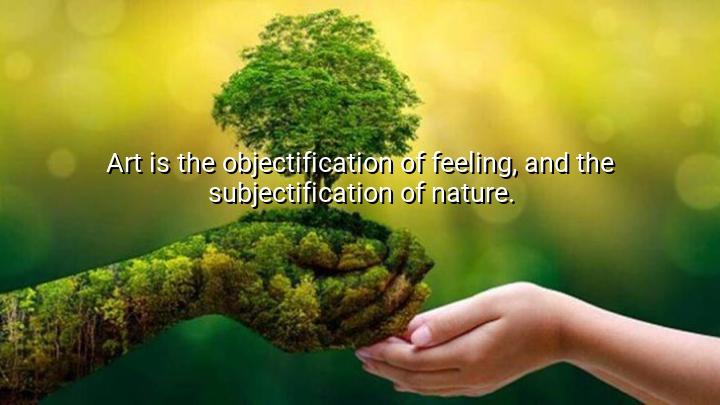




In this quote, Susanne Langer offers a philosophical perspective on the nature of art. She describes art as both the objectification of feeling and the subjectification of nature. The first part of the quote suggests that art takes something as intangible as human emotions—feelings—and transforms them into something concrete and tangible, such as a painting, sculpture, or piece of music. By doing so, art allows us to experience and understand emotions in a more physical and perceptible form, making abstract feelings accessible and communicable.
The second part of the quote, “the subjectification of nature,” implies that artists do not merely represent nature in a realistic manner but interpret it through their subjective perspective. Nature, as it exists in the world, is transformed by the artist’s individual experience and imagination, making the external world a reflection of the artist's inner world. This process suggests that art is not a passive reproduction of the natural world but an active reinterpretation, where nature is infused with the artist's unique emotional and intellectual perspective.
Langer’s distinction between objectification and subjectification underscores art’s dual role: it is both an expression of internal human experience and a personal reframing of the world around us. Art bridges the gap between the internal world of feelings and the external world of nature, capturing both in ways that challenge how we perceive and engage with reality. Through this lens, art becomes a process of transformation, changing raw emotion into form and reshaping nature through the filter of human subjectivity.
Ultimately, Langer’s quote emphasizes that art is a dynamic process that involves both the expression of emotions and the interpretation of the world. It is a means of translating inner experiences into tangible forms while simultaneously transforming the outer world into something deeply personal and reflective of the artist’s individual vision.

TNTung Thi Nguyen
This quote touches something deep in me—especially the idea of 'objectifying feeling.' As someone who struggles to articulate emotions, I often find myself painting or writing instead. Is Langer suggesting that all true art stems from this need to materialize the intangible? If so, then even amateur art has profound value, because it represents a personal truth turned visible.
PLPhuong Linh
I appreciate Langer’s depth here, but I’m left wondering how this idea holds up in digital or AI-generated art. When machines create works without feeling or a subjective view of nature, are they truly making 'art' by her definition? Or is human consciousness a required component for this dynamic of objectification and subjectification to take place?
Llequangdai
There’s something beautifully paradoxical in this quote—transforming feelings into tangible objects while turning the outside world into something deeply personal. But it also makes me think: does this imply that artists are always mediating between inner experience and external reality? If so, does the value of a work of art lie in how well it captures that tension or balance?
DNQuoc Duy Nguyen
I'm intrigued by the philosophical framing here. If art 'objectifies feeling,' does that mean it gives emotions a physical or observable form? And by 'subjectifying nature,' is Langer saying art humanizes or personalizes the external world? This makes me wonder: is this why we find landscapes or still life so moving—because we imbue them with our own subjective feelings without even realizing it?
THdang Thi hien
This quote fascinates me because it flips our understanding of art as either emotional expression or depiction of the natural world—Langer seems to argue that it's both at once. But can all art be viewed through this dual lens? What about conceptual or abstract works where nature isn’t represented at all? Is she suggesting that any emotion captured in form automatically turns nature into something personal and inward-looking?