

Art is the desire of a man to express himself, to record the reactions of his personality to the world he lives in.
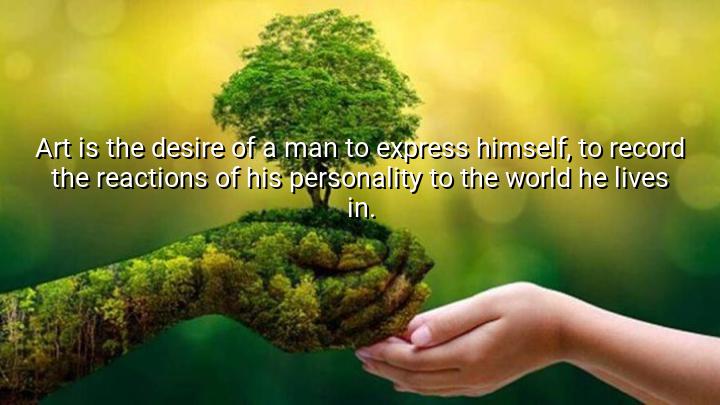




The quote "Art is the desire of a man to express himself, to record the reactions of his personality to the world he lives in" by Amy Lowell emphasizes the deeply personal and expressive nature of art. Lowell, an American poet known for her vivid and emotional poetry, suggests that the essence of art lies in an individual's inner drive to convey their thoughts, emotions, and experiences. Art becomes a means for the artist to communicate their unique perspective on life and the world around them.
Lowell’s perspective also highlights the idea that art is not just about external representations but about how the artist's personality interacts with and responds to their environment. The reactions of the artist to the world—whether through visual art, literature, or other forms—serve as a record of their inner emotional and intellectual landscape. In this way, art becomes a reflection of the artist’s personal journey and relationship with the world they inhabit.
This quote underscores the subjective nature of art. Every piece of art, according to Lowell, is a personal response to the world, shaped by the artist's individual personality and experiences. It is not simply about imitating the external world but interpreting it through the lens of the artist’s own consciousness. Art then becomes a tool for self-expression and a form of communication that transcends words.
Ultimately, Lowell’s words suggest that art serves as both a mirror and a vehicle for self-expression. Through the act of creating, the artist captures and shares their internal experiences with the world. By recording their reactions to life, the artist not only documents their journey but invites others to connect with and reflect on their own experiences, making art a deeply personal and universal form of communication.

MPbui thi minh phung
The quote by Amy Lowell seems to imply that art is almost always a response to one's environment. But what about art that is born out of pure imagination or fantasy? Can such art still be considered a true reflection of the artist’s personality? I often wonder if the boundary between reality and fantasy is ever clear-cut in art. Do you think art loses its authenticity if it is not based on a direct reflection of the world?
TNpham thi ngan
Amy Lowell’s idea about art as a response to the world around us got me thinking: Can art be valid even if it doesn’t reflect the artist’s personal feelings or experiences? What if it’s created purely for aesthetic value or to explore an abstract concept? Do we always need to know the personal context behind a piece to appreciate it? It’s an interesting dilemma that I’ve been trying to work out in my head.
AKAnh Khong
It's interesting how Amy Lowell’s quote sees art as a mirror to the self, but doesn’t that suggest that all art is inherently subjective? Can art that aims to reflect the creator's personal emotions ever truly be universal? I’ve always wondered if art can ever be completely objective, or if it will always carry the bias of the artist’s experiences and personality. What do you think – can art ever transcend this?
VTDo Van Tu
I wonder if Amy Lowell's perspective on art is limiting in some ways. Is the desire to express oneself always rooted in one's personality, or can art sometimes be a form of escapism or reflection on external ideas? Maybe art isn't just a reaction to the world but also a means of creating a world of its own. What do you think – does the world always shape art, or can art create its own reality?
MT26_Le Minh Thu
Amy Lowell's quote captures the essence of art as an outlet for self-expression. But do you think art can sometimes go beyond self-expression and serve as a tool for social change? Can artists still be authentic when they’re pressured to create with an agenda in mind? I’m curious to know whether the personal connection to the world around us always translates into the kind of art that resonates with others. What do you think?