

Art is the daughter of freedom.
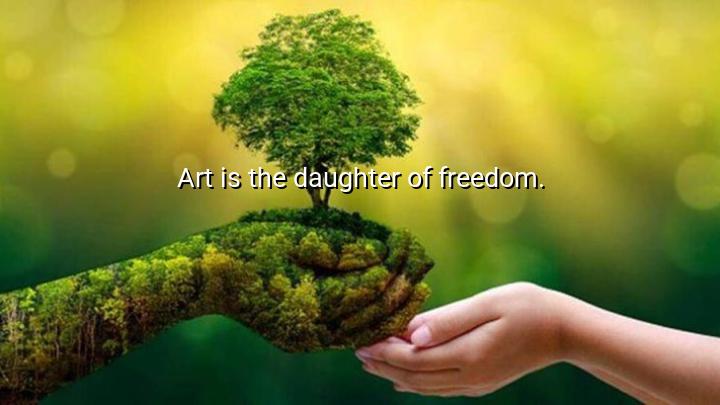




The quote "Art is the daughter of freedom" by Friedrich Schiller emphasizes the idea that art flourishes and thrives in an environment where freedom—both personal and intellectual—is present. Schiller, a German poet, philosopher, and playwright, suggests that true art can only emerge when the artist is free to express themselves without constraint, whether from society, authority, or tradition. Freedom allows the artist to explore their emotions, ideas, and creativity without limits, leading to more authentic and innovative works.
In Schiller's view, art is not simply a form of skill or craft; it is a natural expression of the human spirit that requires freedom to manifest fully. Freedom here refers not just to political or social liberty, but to the mental and emotional freedom that allows the artist to break free from conventional norms and expectations. When artists are free to pursue their own vision, they can create works that are original, profound, and impactful. Without freedom, art can become restricted, confined to rigid formulas or expectations, losing its true essence and power.
This quote also ties into Schiller’s broader philosophical ideas, particularly his belief in the relationship between freedom and human flourishing. Schiller saw art as a vital aspect of human development, where the expression of the inner self through creativity contributes to the individual’s personal growth and the betterment of society. Art becomes a medium through which freedom—both personal and societal—can be expressed, celebrated, and understood.
Ultimately, Schiller’s quote underscores the idea that art and freedom are intrinsically connected. The more freedom an artist has, the more they can develop their unique voice and create works that resonate with deeper truths and emotions. Art, as Schiller suggests, is the product of a free mind, and its beauty and power emerge from the ability to think, create, and express without boundaries.

HQ10CT2-28- Le Hoang Quan
I’m drawn to Schiller’s concept that art is born from freedom. But could there be a deeper meaning here? Perhaps the freedom Schiller refers to isn’t just about being unrestricted in creating, but also about being free in one’s thinking—free to question, explore, and challenge norms. Could it be that the truest art reflects the artist’s internal freedom, rather than just external liberties?
BKBRH K
What’s fascinating about Schiller’s view is how it connects freedom directly with creativity. Does this mean that art can never truly be confined by rules or conventions? If artists are limited by societal norms or external expectations, does their work still reflect freedom, or does it become a forced expression? I wonder, can art be both free and disciplined, or do these two concepts conflict with each other?
HLThi Ngoc Ha Luu
Schiller's quote reminds me of the role of freedom in art, but I wonder, does the type of freedom he speaks of differ across cultures and time periods? Is it freedom of expression, or perhaps freedom from commercial pressures? Could artists in highly controlled societies still create meaningful, impactful art, or does their creativity get stifled by their environment? How far can art go when it’s restricted?
2C2007 Chanh
I find Schiller’s statement intriguing, but it also makes me question: Is art truly the product of freedom, or can creativity emerge from restrictions too? Sometimes constraints can fuel innovation, right? For instance, artists who are limited by resources often come up with unique solutions. So, is freedom essential for art to reach its full potential, or do limitations play an important role in the artistic process?
HLHoa Lee
Schiller’s idea of art as the ‘daughter of freedom’ is a powerful metaphor. Does this mean that true creativity can only flourish when there’s freedom of expression? Can art be fully appreciated or even created under systems of oppression? What does freedom mean in this context? Is it political freedom, personal autonomy, or the freedom to explore any idea, no matter how controversial?