

Art is the concrete representation of our most subtle feelings.
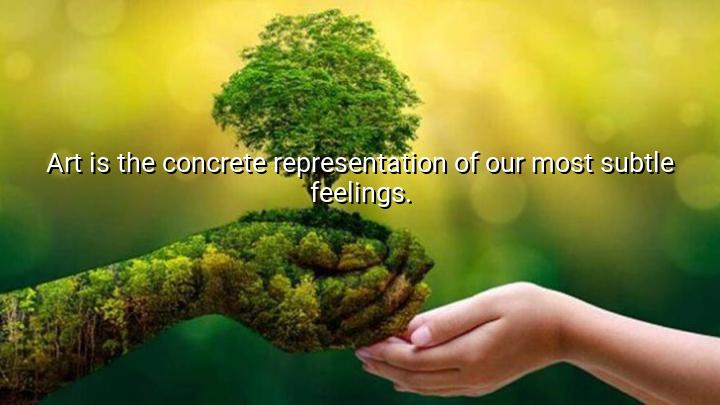




The quote " Art is the concrete representation of our most subtle feelings" by Agnes Martin reflects her belief that art serves as a means of giving form and structure to the intangible and often hard-to-express emotions that reside within us. As an abstract painter, Martin was known for her minimalist works, where she used simple lines and geometric forms to evoke complex emotions. In this statement, she highlights how art can take our most delicate, often fleeting feelings—such as tranquility, introspection, or subtle joy—and translate them into a physical, concrete form that can be experienced visually.
Martin’s idea of concrete representation implies that art offers a way to make something abstract, like an emotion or a thought, visible to others. While feelings are often internal and intangible, art allows them to be externalized in a way that is both understandable and relatable. Through her art, Martin believed that the simplest shapes or arrangements could communicate profound emotional states. For example, her iconic grid paintings, with their soft, repetitive lines, were intended to evoke a sense of calm and contemplation, demonstrating how the subtle can be as impactful as the dramatic in art.
By focusing on subtle feelings, Martin underscores the idea that art is not always about grand, bold statements or overt emotional expressions. Instead, it is capable of capturing the quieter, more nuanced aspects of the human experience. The beauty of art, especially in her minimalist works, lies in its ability to express those feelings that are difficult to articulate—emotions that may not be as easy to pin down, yet are deeply meaningful and significant.
Ultimately, Martin’s quote reveals her view of art as a vehicle for introspection and expression. Art is not just about representing the obvious or the loud but about finding beauty and meaning in the quiet and the subtle. By giving a concrete form to these internal experiences, art allows us to understand and connect with the most delicate and intricate parts of the human condition.

TLNguyen Thi Loan
I appreciate the emotional weight behind this quote. It invites me to consider how much of ourselves artists actually reveal when they create. If art externalizes feelings that are too fine to be spoken, then each piece might be more intimate than we realize. Does this mean artists are constantly exposing their inner worlds, even when their work appears abstract or impersonal? That vulnerability is truly powerful.
PAPham Phuong Anh
Agnes Martin’s perspective really captures the mysterious nature of art. I’m struck by the idea that feelings we might overlook—like fleeting joy or quiet despair—can be embodied in visual form. Have you ever felt like a piece of art understood you better than a person could? It makes me want to revisit works I’ve seen before and look for emotional layers I might have missed.
V942.Le Nguyen Yen Vy 9a5
I find this quote touching and profound. It elevates art beyond technique or style, framing it as a form of emotional honesty. But it also raises a concern—can something so subtle really be understood through something as definitive as a painting or a sculpture? Isn’t there a risk of misinterpretation when translating the abstract into the concrete? Maybe that’s part of the magic, though—the ambiguity itself speaks volumes.
N113Nguyen Ho Thao Nguyen 11a9
This quote makes me wonder: if subtle feelings are so difficult to identify, how do artists become so skilled at making them tangible? Is it through intuition, experience, or a combination of both? I’m curious whether viewers always pick up on what the artist intends—or if each person interprets the work through their own emotional lens, making art a shared but deeply personal experience.
DPDuong Pham
Agnes Martin’s statement feels deeply validating. It makes me think about how hard it is to express delicate emotions—like peace, yearning, or awe—through words alone. Do you think art is more effective than language at conveying these inner experiences? I’ve often found that looking at a painting or listening to music can articulate something I didn’t even know I was feeling. Maybe art is a mirror for emotions we struggle to name.