

Art is the child of Nature; yes, her darling child, in whom we trace the features of the mother's face, her aspect and her attitude.
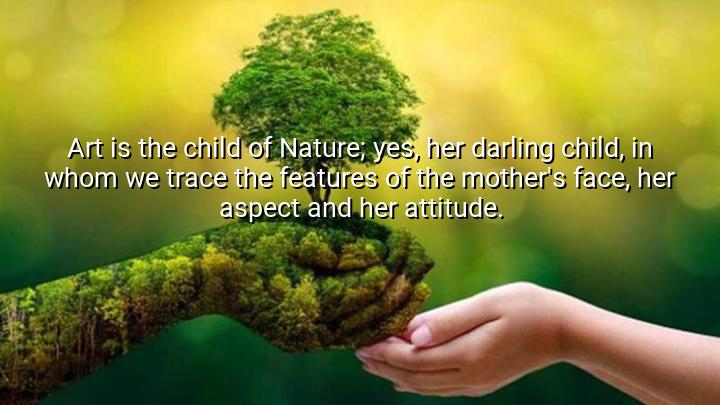




The quote "**Art is the child of Nature; yes, her darling child, in whom we trace the features of the mother's face, her aspect and her attitude" by Beck suggests that art is deeply rooted in Nature and cannot be separated from it. Art is seen as a creation born from Nature, reflecting its forms, beauty, and essence. Just as a child inherits traits from their mother, art bears the marks of Nature—its features, attitudes, and characteristics. This emphasizes the idea that art is not an isolated or artificial construct but is intrinsically connected to the natural world.
In this context, Nature is portrayed as the mother of art, providing both the inspiration and the raw materials for creation. Whether through landscapes, animals, or human experiences, art reflects the world around it. The quote suggests that through art, we can trace the same beauty, structure, and harmony found in Nature, as the artist interprets and recreates these elements in their own work.
The origin of this quote reflects Beck’s view on the relationship between art and the natural world. It echoes the Romantic belief that art should capture the beauty and purity of Nature, and that the artist’s role is to interpret and convey this through their work. By presenting art as Nature’s child, Beck reinforces the idea that art is an expression of the world, rather than something entirely separate or abstract.
By stating that "art is the child of Nature," Beck highlights the organic connection between creativity and the natural environment. Art is not just a representation but a continuation of Nature's essence, a reflection of its beauty, complexity, and attitude. This perspective encourages us to see art as an extension of the natural world, deeply influenced by the features and spirit of Nature itself.

DNDo Ngan
I’m struck by the idea of art carrying Nature’s features—like a child with a parent’s eyes. It gives me a new appreciation for how creative expression isn’t just human invention but a continuation of something older and grander. But I also wonder—what happens when art becomes synthetic or mechanized? Does it lose that maternal imprint, or evolve into a new generation of Nature’s lineage?
HHsjsisjsj
This quote resonates with me because it reminds me how much inspiration artists draw from Nature—whether it’s the symmetry of a flower, the chaos of a storm, or the colors of a sunset. It makes me want to spend more time outdoors, just observing. Do you think this natural inspiration is something conscious, or does it seep in without the artist even realizing it?
DQDuong Quynh
There’s a subtle complexity in this quote. It feels both grounding and elevating at the same time. If art truly reflects Nature’s 'aspect and attitude,' what does that say about the emotional power of landscapes, natural textures, and organic shapes in art? Is our emotional response to art partially a reflection of our deep biological connection to the world around us?
NDNguyen dai
I really like how this quote personifies Nature as a mother and art as her beloved offspring. It paints creation as something familial and intimate. But it makes me ask: what about art that actively challenges or distorts natural forms? Is that rebellion still a form of homage? Or is it something altogether different—art stepping out from Nature’s shadow?
TDTuong Duong
There’s a romantic beauty in viewing art as Nature’s 'darling child.' It implies affection, closeness, and maybe even favoritism. Does that make artists the translators of Nature’s silent language? I love how this idea elevates the act of creating to something almost divine. But I’m also curious—does this relationship work in reverse? Can art influence how we perceive or treat Nature itself?