

Art is science made clear.
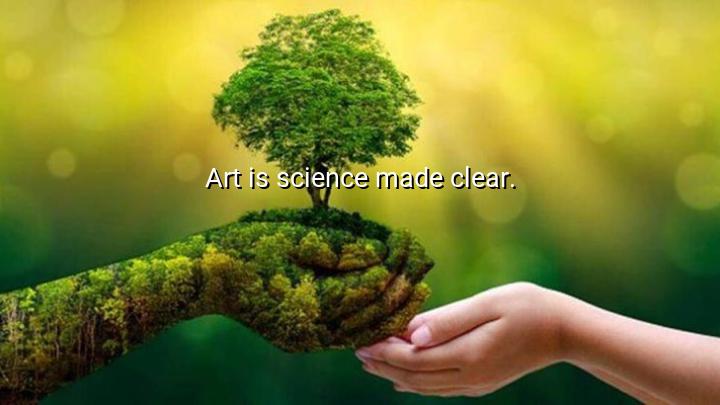




The quote "Art is science made clear" by Wilson Mizner suggests that art and science are closely related, with art serving as the means to make the complexities of science more accessible and understandable. Mizner implies that art takes the often abstract, technical, or complex aspects of science and presents them in a way that is visually or emotionally engaging. It is through art that the truths of science can be communicated in a more tangible, relatable form, allowing a wider audience to grasp scientific ideas and concepts.
In this context, art becomes a bridge between the intellectual and the emotional, making the precision and logic of science more human and accessible. While science is based on facts, experiments, and rigorous inquiry, art distills these ideas into visual or emotional experiences that speak to the viewer’s senses and imagination. Through art, the often cold or distant world of science is infused with creativity and personal expression, making it easier to comprehend and appreciate.
The origin of this quote reflects Mizner’s perspective on the relationship between art and science, both of which require creativity, curiosity, and innovation. Mizner, known for his work as a playwright and humorist, often expressed his ideas in witty and insightful ways. His quote underscores the idea that art and science, though seemingly distinct, are deeply intertwined in their pursuit of knowledge, truth, and understanding.
By stating that "art is science made clear," Mizner emphasizes that art can serve as a powerful tool for simplifying and humanizing complex ideas. It reinforces the idea that art has the ability to take the intellectual rigor of science and transform it into something that resonates emotionally, making it more accessible and engaging for a broader audience.

NTMai Anh Nguyen Thi
This quote makes me think about how often we underestimate the emotional impact of scientific ideas. Climate change data, for example, is just numbers—until you see it in a painting, a documentary, or an installation. Then it hits differently. Maybe art is what gives science a soul, making its truths feel urgent and human. But I also wonder—does this process risk oversimplifying complex information for the sake of beauty or drama?
NPNghi Phuong
Interesting idea, but isn’t art often the opposite of clarity? Some of the most powerful artworks are abstract, ambiguous, or emotionally chaotic. How do those fit into this statement? Maybe Mizner is talking about a specific kind of art—like scientific illustration or conceptual design—rather than art as a whole. Still, it’s a compelling way to frame the relationship between the analytical and the intuitive, even if it doesn’t apply universally.
1U11 updosao
This quote feels both profound and a little provocative. It elevates art by linking it to clarity, but also redefines science as something inherently in need of artistic translation. That makes me ask: where does creativity fit in both fields? Are they separate only in method, not in spirit? Maybe artists and scientists are both seekers of truth, and the quote is highlighting that overlap in a very elegant way.
TGnguyen thanh giang
I love this idea, but I wonder—does it suggest that art is always derivative of science? Or could it be the other way around sometimes? Artists have often anticipated scientific ideas through intuition and imagination. Maybe the relationship is more reciprocal than the quote suggests. I’m curious how scientists feel about this. Do they see art as a tool for explanation, or something that distorts their precision for emotional effect?
PADoan Tran Phuc An
This quote intrigues me because it bridges two fields we often keep separate. Can art really clarify science in a way that textbooks and data can't? I think of illustrations in biology, infographics, or even science fiction—how they make abstract concepts accessible and emotionally resonant. But does that mean art needs science to be meaningful? Or is it that science becomes relatable only when translated into a human, sensory experience through art?