

Art is not supposed to change the world, to change practical things, but to change perceptions. Art can change the way we see the world. Art can create an analogy.
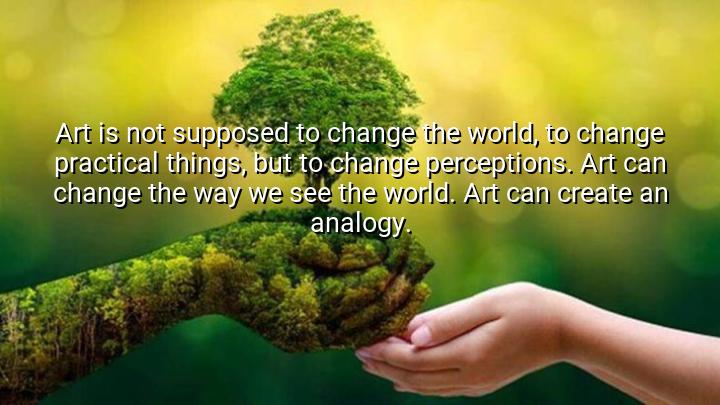




In this quote, JR emphasizes that the primary power of art lies in its ability to transform perceptions rather than directly changing the practical aspects of the world. Art doesn't need to solve problems or make tangible changes; instead, it has the unique ability to alter the way we see and interpret the world around us. By shifting our perspectives, art can prompt deeper reflection, helping us see familiar things in new and profound ways.
The idea of art creating an analogy suggests that it allows us to draw connections between different ideas, experiences, and emotions, often revealing deeper truths about life and society. Through visual representation, art can present complex ideas in a more accessible way, inviting the viewer to understand concepts or situations from a fresh angle. In this way, art serves as a tool for insight and understanding rather than just a medium for expression.
JR's quote reflects his own artistic philosophy, where he often uses large-scale public art installations to challenge the status quo and inspire conversation. His work is aimed at creating a shift in how people perceive their surroundings, their society, and themselves. For JR, art is a powerful vehicle for changing mindsets, not by providing direct answers but by encouraging new ways of thinking about the world.
The origin of this quote comes from JR's belief that art can spark social change by changing individual perceptions. By creating works that provoke thought and discussion, he hopes to inspire action and transformation on a larger scale, all starting with how we view and interpret the world.

NDPhuong Vy Nguyen Dang
The idea of art creating analogies is so compelling. It’s like art doesn’t just reflect reality—it reframes it in poetic terms. I wonder though, are people trained to recognize or value these analogies anymore? With visual media so saturated and fast-moving, can thoughtful, perception-based art still cut through the noise and hold space in the public consciousness?
TTPham Trung thanh
I appreciate JR's perspective—it aligns with the idea of art as a form of metaphorical thinking. But in a world so focused on results, can this subtle shift in perception compete with more direct action? Does art risk being seen as ‘not enough’ in an age of urgency? Or is that exactly why we need it—to resist the demand for immediate utility and nurture long-term change through shifted understanding?
GBphung vu gia bao
I really relate to this quote. Some of the most powerful artworks I’ve seen didn’t give me answers, but changed how I framed the questions. Is it fair to expect art to create solutions, or should we appreciate it more as a mirror or lens? I feel like we sometimes burden artists with fixing problems instead of allowing them to reimagine what’s possible.
QCQuang CT
This makes me wonder about the role of art in times of crisis. If art doesn’t ‘change practical things,’ is it still valuable in activism or social movements? Think of posters, murals, or performance art during protests. Are these just shifting perceptions, or are they also altering realities? Can art truly remain separate from action, or is that separation an illusion?
MPluu thi mai phuong
I find this quote from JR fascinating because it shifts the focus from tangible change to perceptual transformation. But isn’t changing perception one of the most powerful catalysts for practical change? If enough people start seeing the world differently, doesn't that inevitably influence social or political action? I’d love to know whether JR sees these shifts as indirect forms of activism, or if he consciously wants to stop short of that.