

Art is nature speeded up and God slowed down.
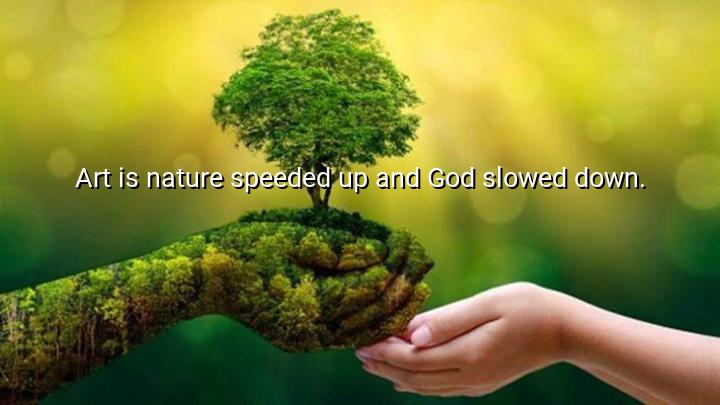




In this quote, Malcolm de Chazal presents art as a process that captures the essence of nature, but in a manipulated form. He compares art to nature that has been "speeded up" and God that has been "slowed down," suggesting that artists enhance or distill the natural world into something more concentrated and intense. While nature unfolds gradually, art distills its elements and forces the viewer to experience it in a heightened, more immediate way. Similarly, by slowing down God, de Chazal implies that art allows us to engage with spiritual or profound elements in a more measured, thoughtful manner.
The origin of the quote comes from de Chazal's work as a writer, artist, and philosopher, who often explored the relationship between the natural world and the human imagination. His view on art reflects a fascination with how human creativity can transform the raw, unprocessed elements of nature into something more refined, yet more intense and impactful. By speeding up nature and slowing down the divine, de Chazal highlights the artist's role in bridging the temporal and the eternal, and in offering a new lens through which we can experience the world.
De Chazal's statement also reflects the idea that art is not simply a reflection of reality but a reimagining or transformation of it. While nature moves at its own pace, art distills and speeds up its processes, compressing time and experience. In contrast, God, or the spiritual or eternal aspect of life, is often beyond human comprehension, but art can bring it into a form that we can more easily grasp. This duality emphasizes the artist's ability to balance the immediacy of the natural world with the profound, slow-moving truths of the divine.
Ultimately, the quote underscores the transformative nature of art and its capacity to shape how we experience the world. Art can capture the essence of nature and divinity, enhancing or slowing down elements of existence in ways that allow us to see, feel, and understand things more deeply. Through this process, art becomes a powerful tool for perception, offering us a heightened experience of both the physical and spiritual realms.

K115 Tran Nguyen Anh Khoa 11v8
There’s something deeply philosophical about this quote, but I’m not sure I fully understand it. Is it saying that art compresses the vitality of nature and stretches out the vastness of the divine so we can understand both? Or is it more about how art alters our perception of time altogether? It feels like there’s an entire worldview embedded in this one sentence. I’d love to unpack that more with others.
HDPhuong Hanh Dan
Is this quote implying that art is a kind of translator between the physical world and the divine? I’m curious about the spiritual undertone here. It’s a beautiful idea, but it makes me wonder—does every artist need to believe in something greater, or can a completely secular worldview also produce art that slows time, that uplifts, that reveals the essence of nature or life?
NOnguyen Oanh
This quote really resonated with me as someone who spends a lot of time in nature and also paints. It made me think about how art can capture fleeting impressions—a cloud shape, a breeze, a bird's cry—things that vanish in seconds but get preserved on a canvas. Is that the 'speeding up' of nature? And the 'slowing down' of God—maybe it’s the act of pausing to observe the sacred in ordinary things?
TLHuynh Pham Thao Linh
I love how this quote elevates art to something beyond human effort. It implies that creating art is a way of interacting with forces greater than ourselves. But I wonder—how does this view reconcile with the more technical or commercial sides of art? Are artists always channeling nature and divinity, or can the process also be grounded, flawed, and very human?
TDTrinh Dao
What an interesting image—art caught between nature and divinity, speed and stillness. But is that duality always present in every piece of art? I wonder if this quote romanticizes art in a way that excludes more disruptive or contemporary forms. Can a chaotic digital installation or performance art piece still fit this definition, or does it only apply to more traditional or contemplative work?