

Art is man's expression of his joy in labor.
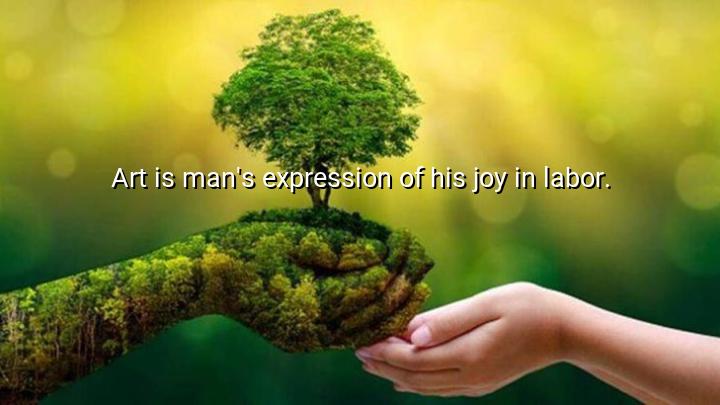




The quote "Art is man's expression of his joy in labor" by Henry Kissinger suggests that art is not just about aesthetic creation or intellectual pursuits, but it is a deep and personal expression of satisfaction and fulfillment derived from the act of working. Kissinger highlights the idea that art is intrinsically tied to the process of labor, where the artist finds meaning, joy, and personal connection through their work. In this sense, the act of creating is not just a means to an end but a source of deep emotional and spiritual satisfaction.
Kissinger, primarily known for his role in politics, provides a perspective that blends his understanding of human nature with the creative process. His statement implies that the value of art is rooted in the effort and commitment the artist invests in the creation, where each stroke, note, or movement is an expression of their joy in the laborious act of bringing something into existence. The process itself, rather than the final product, is what allows the artist to connect with their emotions and express them to the world.
The origin of this quote can be understood in the context of Kissinger’s broader views on human work and fulfillment. While he is best known for his diplomatic and political work, his understanding of human expression extends to the arts, where he recognized that art could serve as a reflection of both intellectual and emotional engagement. For Kissinger, labor was not a mere task but a meaningful process that contributed to personal growth and expression, and art was one of the purest forms of such expression.
For artists, this quote serves as a reminder that art is a journey, and the joy they find in the creative process is just as important as the finished product. It encourages creators to embrace the effort and dedication that go into their work, knowing that labor itself can be a source of fulfillment and a powerful means of expressing their innermost feelings.

CVVui Chau van
Reading this, I’m reminded of how different cultures view the relationship between work and creativity. In some traditions, making things—like weaving or pottery—is both practical labor and artistic expression. Maybe Kissinger’s quote touches on that idea. But I wonder if in a capitalist context, where work is often exploitative, the joy part gets lost. Can we really talk about joy in labor when so many artists struggle to make ends meet?
MAPham Minh Anh
There’s a really optimistic tone in this quote, and I admire that. It assumes that art emerges from a kind of love for the work itself, which I find inspiring. But I also wonder—does this view romanticize labor? For many, labor isn’t joyful; it’s survival. So is art still an expression of joy in those cases, or is it more of a coping mechanism, or even a cry for liberation?
BTHung Bach Thanh
This perspective makes me wonder if Kissinger is equating all artistic expression with productivity. That feels a little reductive to me. Can’t art also be an act of rebellion, grief, or chaos? Joy is one part of the spectrum, but certainly not the only motivation behind creative work. Does this quote unintentionally overlook the many emotions that fuel artistic labor beyond just pleasure or pride?
PPPH
I’m curious about the connection between joy, labor, and art. In today’s world, where labor often feels exhausting or dehumanizing, can art still reflect joy in work? Or is this quote more idealistic—maybe even nostalgic for a time when craftsmanship was more valued? What happens when art is produced under pressure, for money, or out of necessity? Is that still joy, or does it become something else entirely?
DPDUNG PHAM
This quote surprised me, especially coming from Henry Kissinger. Is he implying that art is primarily a byproduct of work, rather than inspiration or emotion? It makes me think: is the creative process itself a form of labor, or is it something more sacred and spontaneous? And what about artists who struggle, suffer, or feel burdened by their work—does their art still count as a joyful expression of labor?