

Art is man's constant effort to create for himself a different order of reality from that which is given to him.
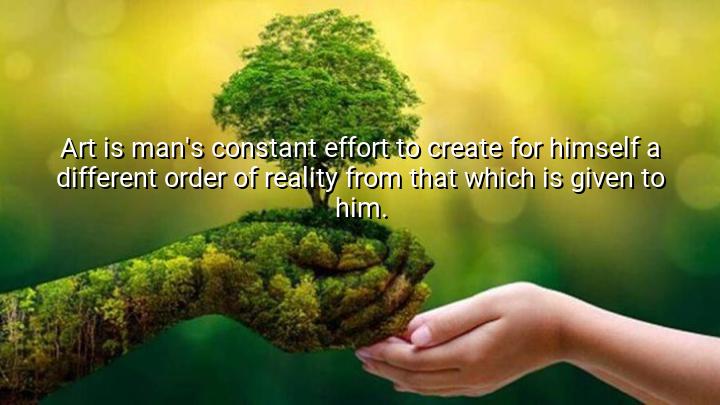




The quote "Art is man's constant effort to create for himself a different order of reality from that which is given to him" by Chinua Achebe speaks to the role of art in shaping and transforming human experience. Achebe, a renowned Nigerian writer and critic, suggests that art allows individuals to step beyond the limitations of the reality they are born into and create alternative worlds that reflect their own visions, emotions, and truths. Through art, humans engage in an ongoing creative process that challenges and redefines the reality imposed upon them by society, culture, or circumstance.
Achebe's statement implies that art is not merely an imitation of the world but a way of reimagining and reconstructing it. Artists, whether through literature, painting, music, or other mediums, have the power to shape new realities that reflect their inner lives, struggles, and ideals. This process allows people to express their desires for a different world, one that might be more just, more beautiful, or more aligned with their hopes and dreams.
By describing art as a "constant effort", Achebe emphasizes that this act of creating new realities is not a one-time event but an ongoing and persistent struggle. Artists continually seek to transcend the world as it is, to offer a vision of what could be, thus challenging both themselves and their audiences to think differently about the world around them. In this sense, art becomes both a personal and collective act of resistance, reflection, and transformation.
Ultimately, Achebe’s quote underscores the transformative power of art in shaping human consciousness and the world. It suggests that art is not merely a passive response to the world but an active and dynamic force that can alter our perceptions and create alternative possibilities for human existence. Through art, individuals strive to make sense of, and sometimes escape from, the given reality, while also envisioning and pursuing something better.

QLNguyen Quoc Linh
Achebe’s quote feels timeless. It makes me think about how marginalized communities use art to rewrite their place in history. Is this what he meant by a 'different order of reality'—one that includes voices left out of the dominant narrative? If so, art isn't just a luxury or form of entertainment, but a deeply necessary act of reclaiming identity and agency.
TH09. Thu Huyen
I love the idea that art is an intentional reshaping of what we’re given. But does this apply to all kinds of art? What about spontaneous or unconscious creativity—like doodles or improvisational music? Are those still attempts at a new order, or just expressions of the moment? I’m curious how much intention plays into Achebe’s view of artistic purpose.
BTNguyen Ngoc Bao Thy
This quote got me thinking about escapism in art. When life feels chaotic or unjust, art can be a way to cope by imagining something better. But is there a risk that this kind of creation detaches us from action? Can building new realities through art inspire real-world change, or does it sometimes make us complacent by giving us a safe space to hide?
TTTran Thi Trang
As someone who creates, this quote resonates deeply. It feels like Achebe is describing that constant itch artists have to 'make sense' of life in their own terms. But I also wonder: what about art that aims to reflect reality as it is, like documentary photography or realist painting? Is that still a form of creating a different order, or is it more about sharpening our view of the existing one?
VTNguyen van thuong
Achebe’s words make me think about the political power of art. If art is an effort to reframe reality, then it has massive potential to challenge dominant narratives and structures. But that also makes me wonder—can art ever be truly neutral? Even the most personal or abstract work might still reflect a desire to reshape the world in some way. Is all art inherently political, then?