

Art is I; science is we.
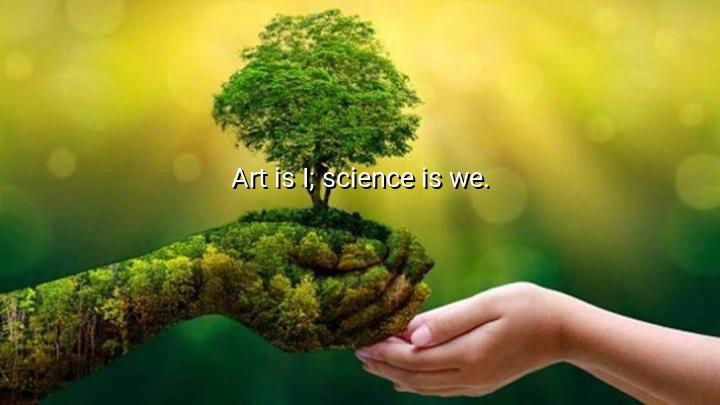




The quote " Art is I; science is we" by Claude Bernard highlights the distinction between the personal, subjective nature of art and the collaborative, objective nature of science. Bernard, a French physiologist often considered the father of modern experimental medicine, is pointing out that art is an individual expression of the self—something created from personal experience, emotion, and perspective. The artist’s identity is often inseparable from their creation, making art a deeply personal endeavor.
On the other hand, science is described as we, emphasizing the collective and collaborative nature of scientific inquiry. Unlike art, which may be shaped by a single individual’s vision, science is a shared pursuit, built upon the contributions and knowledge of many people. Scientific progress relies on the collective efforts of the global scientific community, where discoveries are tested, refined, and expanded upon by others. Science is rooted in facts, empirical data, and universal truths, which are accessible and verifiable by all.
Bernard’s quote also underscores the difference in how art and science are experienced. Art often reflects the individual’s internal world and allows for personal interpretation and emotional connection. In contrast, science aims to transcend individual bias by establishing objective truths that are universally applicable and can be verified by others. This division reflects a philosophical view where art is about personal expression, while science is about objective knowledge that belongs to humanity as a whole.
In essence, Bernard's quote serves to highlight the contrasting roles of art and science: art as the expression of individual creativity and identity, and science as the collective endeavor to understand and explain the world. Each serves a unique purpose, one rooted in the personal and the emotional, the other in the universal and the rational.

TPThao Phuong
This quote struck me as beautifully concise but also left me with questions. If art is centered on personal expression, does that mean it can't or shouldn't aim for universal truths the way science does? And on the flip side, is science truly impersonal, or do the biases and values of individuals still shape it? I’d love to explore how Bernard might’ve interpreted interdisciplinary fields, like psychology or design, where 'I' and 'we' constantly interact.
HHieu
I get what Bernard is trying to say, but doesn’t it seem a bit dated? In today’s world, artists build online communities, collaborate across continents, and influence social movements. Meanwhile, scientific discoveries often start with one person’s unique vision or hypothesis. I think the quote captures a poetic truth, but reality is more complex. Are we moving into an era where both art and science must be both 'I' and 'we' to make an impact?
QCNguyen Quynhh Chi
From a psychological perspective, this quote hits on something profound. Art often stems from subjective experience, emotions, and inner life, while science aims for objective truth and shared understanding. But is that a false dichotomy? Aren’t both fields driven by curiosity, observation, and creativity? I'm curious how Bernard, a scientist himself, reconciled these realms. Did he view art as self-expression and science as a communal tool for survival? Or is there more overlap?
TPNGUYEN TANG PHUNG
I find this quote both elegant and a bit troubling. It romanticizes art as personal expression, which I appreciate—but does it risk overlooking how art can also be political, communal, or even scientific in its method? Likewise, science isn’t devoid of ego or individual creativity. Do you think Bernard saw this more as a philosophical contrast or a literal division? I'm not sure the line between personal and collective is ever that clean.
TNThuy Ngoc
This quote really makes me think about the roles of individuality and collaboration in human progress. Is Bernard implying that art is a solitary, introspective pursuit while science is inherently collective? That feels somewhat true, but I wonder if it oversimplifies things. Aren’t there deeply collaborative art forms—like filmmaking or theatre—and solitary scientific breakthroughs? Does this distinction still hold up today, or have the boundaries between 'I' and 'we' started to blur more?