

Art is Art. Everything else is everything else.
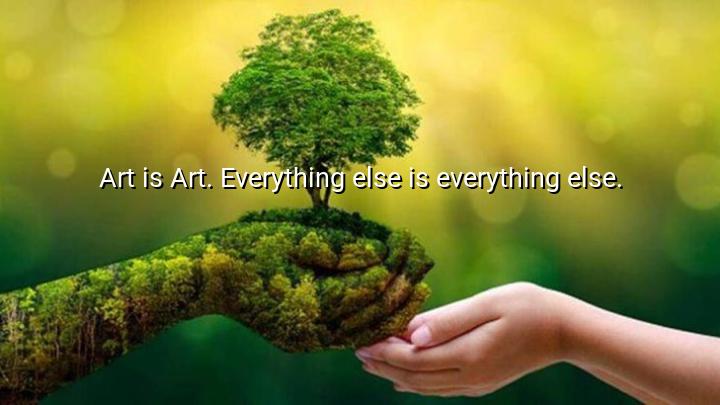




The quote " Art is Art. Everything else is everything else" by Ad Reinhardt emphasizes the idea that art exists in its own realm, separate from other aspects of life. Reinhardt, a painter known for his work in abstract art, particularly minimalist painting, suggests that art should not be diluted or confused with other things, whether they are societal trends, commercial products, or other cultural elements. For Reinhardt, art is a pure form of expression that should be judged and appreciated on its own terms, without being weighed down by external influences.
By drawing a clear distinction between art and "everything else," Reinhardt advocates for the autonomy of art as a discipline. He believed that art should be about its own inherent qualities—such as form, color, texture, and composition—rather than being a tool for political agendas, commercial interests, or even personal expression in the conventional sense. This aligns with Reinhardt's minimalist approach, where he stripped his work of extraneous elements to focus solely on the art itself, aiming for purity and simplicity.
Reinhardt's quote also reflects a critique of the commercialization and commodification of art. In an era where art was often being commercialized and used for advertising or other non-artistic purposes, Reinhardt wanted to remind people that art should remain true to its purpose—creating aesthetic, emotional, and intellectual experiences. His statement is a call to elevate art above the noise of external factors and distractions, urging both artists and audiences to focus on the intrinsic value of art itself.
Ultimately, Reinhardt's quote serves as a declaration of art's independence and purity, advocating for its separation from the everyday concerns and distractions of life. In his minimalist view, art should stand on its own, free from commercial, social, or political influences. Through this clear differentiation, Reinhardt highlights the unique role of art in society and emphasizes the importance of appreciating it for its own sake.

HTTran Ngoc Huyen Trang
I’m torn between admiration and confusion. Is Reinhardt suggesting that art is pure only when it’s untouched by narrative, function, or interpretation? That seems awfully rigid. How would he view modern digital or interactive art forms that depend on audience participation? I wonder if this stance still holds in today’s fluid, hybrid creative world. Is it still useful to draw such hard lines between disciplines, or has that idea aged out?
HDHongvan Dao
This quote made me smile. It’s so minimalist, yet provocative. But I’m wondering—does it open the door to a broader philosophical question about identity and categorization? If art is a self-contained concept, how do we deal with interdisciplinary works or performance pieces that blur boundaries? Could this statement be more about the artist’s mindset than about the artwork itself? It feels like a Zen koan almost.
NANguyen Ngoc Anh
Isn't there something kind of elitist in this viewpoint? It feels like Reinhardt is putting art on a pedestal, separating it from the messiness of life. But what about art that’s rooted in social justice or personal trauma—does that not count anymore? I respect the desire for purity, but it makes me uncomfortable. Shouldn’t art be allowed to be messy and political and emotional too?
LA7/11-04 Dinh Lan Anh
I love how uncompromising this statement is—it really makes me think about how we define art. Do you think Reinhardt was reacting to the commodification of art, like saying, 'Stop mixing it with business or politics'? It’s almost spiritual, the idea that art should stand alone. But can it really, in a world where context is everything? Can we ever look at a painting without seeing all the ‘everything else’ in it?
NNam
This quote feels kind of dismissive, almost like it's gatekeeping what 'counts' as art. It makes me wonder who gets to decide what belongs inside the 'art' category and what doesn't. Can something be both art and functional, like design or architecture? Or is that exactly what Reinhardt was trying to exclude? I'm curious about how this line of thinking affects inclusivity in creative spaces.