

Art is activism.
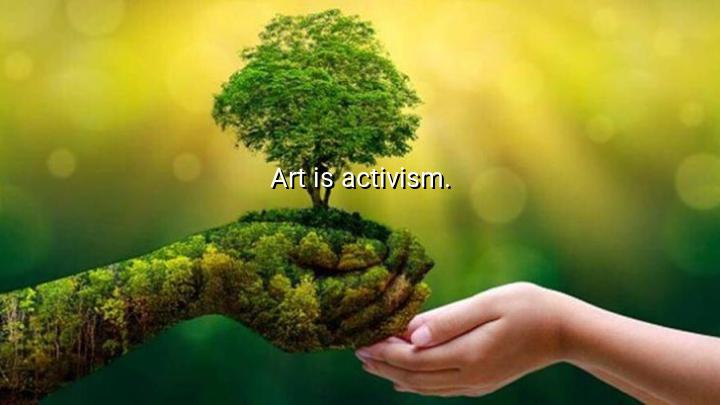




In this concise statement, Angie Thomas asserts that art is inherently linked to activism. She emphasizes that art is not just a form of self-expression or aesthetic enjoyment, but also a powerful tool for social change and political action. By calling art activism, Thomas suggests that artists have a responsibility to address social issues, raise awareness, and challenge existing power structures through their work. Art becomes a medium for advocating for justice, equality, and change.
Thomas's statement reflects the idea that art is often a form of resistance—whether through literature, music, visual art, or performance—that directly engages with the struggles and challenges faced by marginalized communities. Artists can use their platform to draw attention to inequality, oppression, or human rights abuses, transforming their creative work into a call for action. This approach to art encourages people to not only appreciate its beauty but to recognize its potential to inspire action and spark important social conversations.
The quote also suggests that art is more than just a reflection of the world; it is an active force that can drive societal transformation. Activism through art engages audiences emotionally and intellectually, often pushing them to question their beliefs and take a stand on critical issues. By viewing art as activism, Thomas highlights how creative work can serve as a form of empowerment for both the artist and the audience.
Ultimately, Thomas's quote challenges the separation between art and activism, urging us to see them as interconnected. Art, when used effectively, becomes a tool to highlight injustices and inspire people to take part in the process of change, turning passive appreciation into active engagement in the fight for a better, more equitable world.

MNMai Nguyen
If art is activism, then what responsibilities do artists have toward their audiences? Should they be held accountable for the messages they put out, or for remaining silent on major issues? This quote really makes me question the role of art in society—not just what it represents, but what it’s supposed to *do*. Can we separate art from activism in any meaningful way anymore?
NQng quyen
This resonates deeply, especially in today’s climate where artists of all mediums are often on the front lines of cultural change. But I wonder if this perspective places pressure on artists to always have a 'message' or be socially relevant. Can that stifle creative freedom, or is it just a reality of being an artist in a politically charged world?
KTkien tran
I find this quote empowering, especially for marginalized voices who use creative expression to be seen and heard. It validates that making art isn’t just self-expression—it’s resistance, it’s presence. But does calling all art activism risk diluting the meaning of activism itself? Where do we draw the line between personal expression and purposeful action aimed at change?
PALa Phuong An
The idea that art is inherently a form of activism makes me reflect on how often artists have shaped public opinion and sparked movements. But what about commercial or decorative art—can that also be activism? Or is it only when the intent is explicitly political or social? I'm curious how broad the definition of activism should be when we apply it to art.
CChung
This quote makes a bold and compelling claim. I admire the clarity and power in linking creativity directly with activism. But I wonder—can art still be considered valid or meaningful if it doesn’t aim to challenge the status quo or advocate for change? Does all art need to carry a political or social message, or is there room for art that simply explores beauty, emotion, or imagination without that intent?