

Art is about changing what we see in our everyday lives and representing it in such a way that it gives us hope.
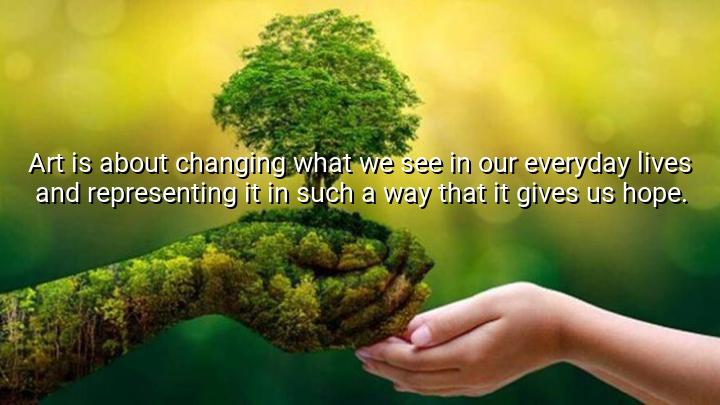




Kehinde Wiley’s quote reflects his belief that art has the power to transform how we perceive the everyday world. When he says, “Art is about changing what we see,” he highlights the idea that artists don’t just copy reality—they reinterpret it. By altering how ordinary life is represented, art can reveal hidden beauty, dignity, or strength that might otherwise go unnoticed. It becomes a tool for reimagining the familiar in ways that inspire and uplift.
Wiley, best known for his vibrant and regal portraits of Black subjects, often places his figures in traditionally European artistic settings, challenging historical narratives. His work brings visibility to people who have been historically excluded from classical art, thereby reshaping cultural identity and offering a new perspective on representation. Through this process, Wiley’s art offers a sense of hope, dignity, and empowerment to communities that have long been marginalized.
The phrase “gives us hope” emphasizes the emotional and social impact of art. Wiley believes that by seeing ourselves or others portrayed with honor and beauty, we can find strength and inspiration. Art becomes more than decoration—it’s a form of affirmat

LNLam nguyet
Wiley’s take on art gives me a lot to think about. Is he suggesting that representation itself—especially of underrepresented groups—has an inherently hopeful quality? If so, that really emphasizes how powerful visibility can be in visual culture. But what happens when representation is co-opted or misused? Can the hopeful intent of art be distorted when taken out of its original context?
BBxbdhdhdhdhd
I really admire this perspective, but I’m curious how it applies to artists whose work is deeply personal rather than social. Can self-expression through art—like journaling or abstract painting—still be about changing perception and offering hope, even if the artist isn’t consciously aiming for that? Or does the impact have to be more outward-facing to fit this idea?
TDThanh Danh
This idea really resonates with me, especially in a world that often feels chaotic or heavy. But I wonder, does all art need to inspire hope to be considered meaningful or successful? What about abstract pieces or conceptual works that don’t clearly reflect everyday life? Do they still fulfill this role, or do they fall outside Wiley’s vision of art?
TTNguyen thi thao
I love how this quote frames art as a transformative force in daily life. But I’m curious—can art still be hopeful if it portrays struggle or injustice? Some of the most impactful pieces I’ve seen are raw and painful, yet they’ve sparked important conversations. Is hope in this context about envisioning change, even when the subject matter is dark?
GHLe Gia Huy
Wiley’s quote makes me reflect on the emotional role of art—do you think hope is the ultimate goal of all artistic expression, or just one powerful possibility? While some art uplifts, others provoke discomfort, anger, or sadness. Can those emotions still lead to hope indirectly, or are they serving a different purpose entirely? I wonder if hope in art is more about the viewer’s interpretation than the artist’s intention.