

Art is a collaboration between God and the artist, and the less the artist does the better.
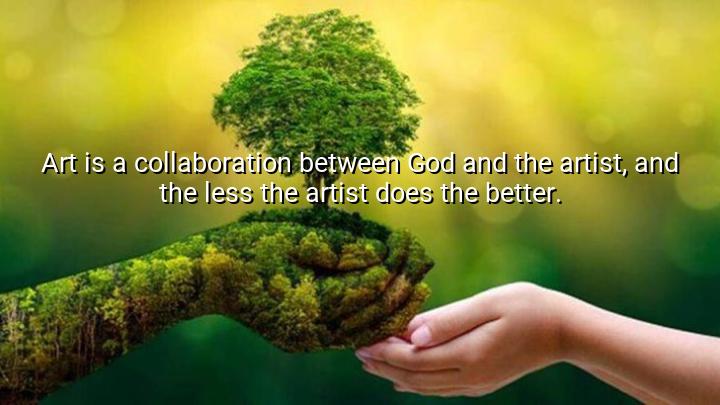




The quote " Art is a collaboration between God and the artist, and the less the artist does the better" by André Gide reflects his belief in the divine nature of art and the artist's role in the creative process. Gide suggests that art is not purely a product of human effort, but rather a collaboration with a higher power. In this view, the artist acts as a vessel through which divine inspiration flows, and the more the artist attempts to control or manipulate the process, the less pure or authentic the work becomes. The artist's task, then, is to step back and allow the creative energy to guide the work.
Gide’s statement also emphasizes the concept of passive creation, where the artist is less focused on exerting their own will and more on allowing the work to emerge naturally. The less interference there is from the artist’s ego or conscious effort, the more the art becomes a true expression of the divine or universal truths. This approach aligns with certain artistic philosophies that prioritize intuition, spontaneity, and the ability to trust in the creative process rather than overthinking or forcing the outcome.
Additionally, Gide’s quote can be interpreted as a critique of the over-intellectualization or over-explanation of art. By emphasizing the role of God in the creation of art, he suggests that the true essence of a work lies in its authenticity and connection to something greater than the individual artist. When artists try to impose too much of themselves on their work, they risk losing that divine connection and the purity of the creative experience.
Ultimately, Gide’s quote speaks to the humble nature of the artistic process, suggesting that the artist should not take full credit for the work, but rather acknowledge their role in channeling a higher force. In this sense, art becomes a spiritual practice, where the artist facilitates a connection between the divine and the human, resulting in work that transcends individual effort and reflects a greater universal truth.

TCPham Thi Cuc
I'm fascinated by the implication that doing less results in better art. Is Gide criticizing over-intellectualizing or over-working a piece? Maybe he's advocating for a more instinctive, subconscious form of expression. But then, does this undervalue the years of training many artists undergo? I'd love to know how others balance intuition with craft. Is it possible that letting go is a learned skill just like technique?
T2Cao Thu 2D
There's something both humbling and intimidating about this quote. It implies that the artist’s job is to step aside and become a vessel. But what happens to personal style, cultural influence, or conscious messaging in that process? Is there a line between channeling inspiration and abdicating responsibility for what you create? Can we really say we made something if we believe it came from a divine or external source?
QPLAI QUOC PHONG
Honestly, this quote feels both poetic and provocative. It’s as if Gide is saying the best art is almost accidental—or divinely channeled. But does that mean artists shouldn't revise, plan, or refine their work? That seems unrealistic in a world where deadlines, training, and technique matter. I’d love to know how this idea translates into real-world artistic practices, especially in structured or commercial art environments.
TTTien Thuy
I'm intrigued by the theological tone here. Referring to art as a collaboration with God raises questions—what about secular artists or those who don’t believe in a higher power? Can this quote be interpreted metaphorically, like 'God' representing the muse or creative flow? Or is it inherently religious? Either way, it seems to suggest that great art comes from letting go of ego. But how practical is that, really?
Bbuithichauanh
As someone who believes deeply in the discipline behind art, this quote challenges me. Is Gide suggesting that too much conscious effort can actually block true artistic expression? I wonder how this applies to modern digital artists or designers who rely heavily on tools and technique. Is it possible that over-involvement kills authenticity? Or does it just evolve the form of collaboration with something bigger than ourselves?