

Art in Nature is rhythmic and has a horror of constraint.
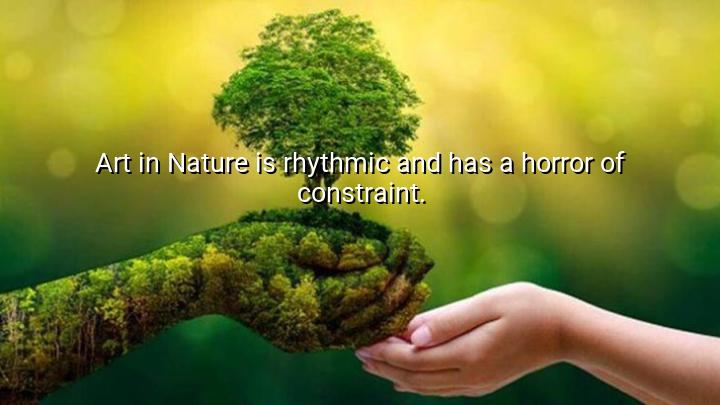




The quote " Art in Nature is rhythmic and has a horror of constraint" by Robert Delaunay speaks to the organic and fluid qualities of nature and how they inspire art. Delaunay, a prominent artist and key figure in the Orphism movement, believed that nature is inherently dynamic, with rhythms and patterns that flow without restriction. By describing nature as "rhythmic," he emphasizes the natural pulse and harmony found in the world around us. This rhythm is not rigid or confined but is free-flowing and constantly evolving, much like the art that seeks to capture it.
Delaunay's reference to art having a "horror of constraint" reflects his view that artistic expression should mirror the limitless and unrestricted qualities of nature. He suggests that true art should not be confined by rigid structures or conventions. In his own works, Delaunay embraced color, light, and form in ways that broke away from traditional representations, allowing the viewer to experience a more dynamic, fluid interaction with the world. The "horror of constraint" is a rejection of limits, a desire for art to evolve and flow as naturally as the world itself.
This idea is central to Delaunay’s approach to art, where he focused on using vibrant colors and abstract forms to convey the energy and motion he saw in nature. Through his exploration of rhythm and color, particularly in his circular compositions, Delaunay sought to capture the unrestrained beauty and perpetual motion of life. For him, art was not just about representation but about expressing the dynamic forces that drive nature.
Ultimately, this quote reflects Delaunay’s belief that art should reflect the organic, ever-changing rhythms of the world, free from the constraints of traditional methods and rules. It challenges artists to embrace the fluidity and energy of nature, creating works that are as vibrant and dynamic as the world around us.

NHphung ngoc han
I’m intrigued by the idea that nature *is* art, and that its defining qualities are rhythm and rebellion against restriction. But what happens when we try to imitate that in human-made spaces—gardens, architecture, city design? Can we ever fully capture nature’s essence, or does the act of planning already impose too much constraint? It raises a deeper question: can the artificial ever feel truly organic?
TDThuy Dao Thi Diem
This quote feels liberating to me. As someone who often gets caught up in perfectionism, it’s a reminder that natural beauty thrives in asymmetry and motion. But how do we tap into that rhythm in a digital, hyper-organized world? Is modern life too constrained for this kind of freedom? Maybe that’s why so many artists are drawn to nature—it re-teaches us how to create with flow instead of control.
MNMinh Nguyenvan
Reading this, I immediately thought of jazz music and abstract painting—both feel rhythmic, organic, and unbound. But then, isn't rhythm itself a kind of structure? Nature has seasons, cycles, patterns. So is Delaunay contradicting himself, or is he pointing to a *natural* rhythm that resists *artificial* constraint? I’d love to hear interpretations from dancers or musicians—how do they sense rhythm without feeling boxed in?
NNnguyen thi ngoc nhi
I love the phrase ‘horror of constraint.’ It gives nature such a wild, untamed personality. But does that mean any form of artistic control—editing, sketching, refining—is a betrayal of nature’s essence? Or is it possible to find rhythm within discipline? I’m curious where people draw the line between necessary structure and creativity-killing rigidity. Can the two ever work together, or are they fundamentally at odds?
TQPhan Tu Quynh
This quote makes me wonder: if art in nature is inherently rhythmic and resists constraint, does that mean human-made art should aim to be just as free and fluid? I often struggle with structure and rules in my creative process—composition, form, balance. But maybe Delaunay is suggesting that true artistic power lies in spontaneity and movement. How do artists reconcile this natural rhythm with the technical demands of their medium?