

Art, freedom and creativity will change society faster than politics.
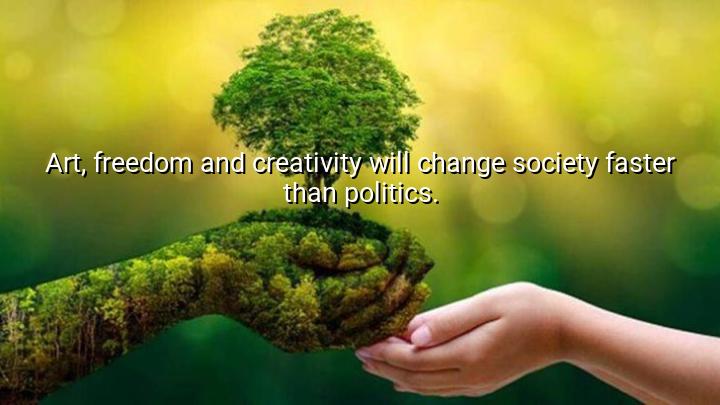




Victor Pinchuk's quote, "Art, freedom and creativity will change society faster than politics," suggests that the power of art, freedom, and creativity can have a more immediate and profound impact on society than political systems or policies. Pinchuk emphasizes that while politics often moves slowly due to bureaucratic processes and complex power dynamics, art and creative expression have the ability to spark change quickly by inspiring individuals and challenging existing norms.
The phrase "freedom and creativity" underscores the importance of personal expression and the ability to think outside conventional boundaries. Pinchuk argues that when people are free to express themselves and engage in creative activities, they can push the boundaries of society in ways that are not constrained by political institutions or ideologies. Creative works, whether in art, music, literature, or other forms, can provoke deep reflection and motivate people to question and transform the status quo.
Pinchuk’s belief in the power of art to drive change is rooted in the idea that it speaks directly to the emotions and consciousness of individuals. Unlike politics, which often deals with laws and regulations, art influences culture, shaping public opinion and collective identity. Through powerful imagery, narratives, and performances, artists can communicate messages that resonate on a deeply personal level, inspiring widespread societal shifts.
In this quote, Pinchuk highlights the speed and impact of cultural change. While political change can be gradual and often requires consensus-building, art and creativity can bring about rapid transformation by reaching people at a grassroots level. Through creative movements, societies can evolve quickly, challenging long-held beliefs and fostering new ways of thinking and living.

PNPhuong Nguyen
I see where this is coming from, especially in how quickly viral content and digital art can spark movements nowadays. But is speed really the best metric for societal change? Political change might be slower, but it tends to have legal permanence. Could it be that art initiates the spark, but politics cements the outcome? I’d love to hear how people define the roles of each in shaping a just society.
KNVo Nguyen Kim Ngan
This is a fascinating idea, but how does it apply in repressive societies where freedom of expression is restricted? In those cases, politics actively suppresses art. Does the quote still hold true there? Or is it assuming a level of freedom that not all societies enjoy? I’m wondering whether the effectiveness of art and creativity in changing society depends on the political environment more than the other way around.
TANguyen trung anh
I really resonate with this quote. When I think about how music, literature, and street art have shaped public consciousness—especially among younger generations—it feels like a more organic form of revolution. People connect with ideas emotionally before they act politically. Maybe the quote is highlighting that cultural shifts often precede legal or structural change. Could that mean we need to invest more in cultural education and creative platforms to accelerate progress?
DDao
It sounds inspiring, but is it a bit too optimistic? I mean, art has the power to start conversations and shift perceptions, but doesn’t politics hold the power to actually implement changes? Sometimes I worry that overemphasizing art’s role might let governments off the hook. Is there a danger in expecting artists to take on the burden of change while the political system stagnates or resists progress?
DTDung Ta
This quote got me thinking about how deeply art can affect people emotionally. A film or painting can shift someone’s worldview overnight, while political change often feels slow and bureaucratic. But I wonder—can emotional or cultural change sustain itself without political backing? For instance, civil rights art was powerful, but wasn’t it policy that ultimately secured protections? How do we balance emotional influence with structural action?