

Art evokes the mystery without which the world would not exist.
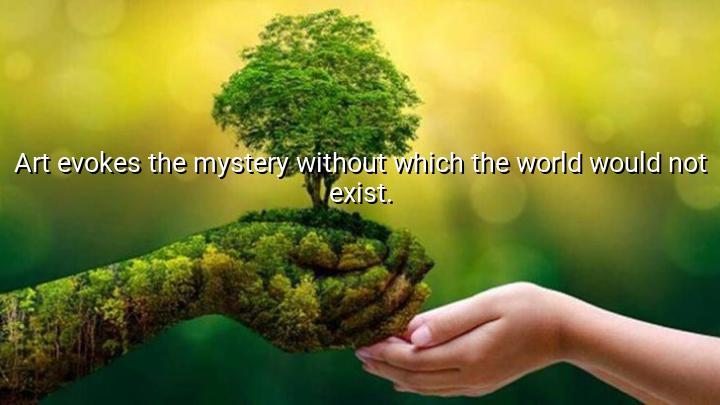




The quote " Art evokes the mystery without which the world would not exist" by René Magritte highlights the essential role that art plays in our understanding of the world. Magritte, a leading figure in the Surrealist movement, believed that art has the power to reveal deeper, often hidden truths about reality. According to him, mystery is not something to be solved, but something that sustains the wonder and complexity of the world. Art brings this mystery to the forefront, allowing us to engage with and contemplate aspects of life that are beyond logical explanation.
Magritte’s statement suggests that the world, without the sense of mystery, would lose its depth and intrigue. Art serves as a bridge to this mystery, inviting the viewer to experience something beyond the mundane or obvious. In Surrealism, artists often use unexpected juxtapositions and dreamlike imagery to challenge our perception of reality, revealing the underlying mysteries that shape our existence. Art does not provide answers, but it forces us to confront the unknown, keeping the world alive with possibility and wonder.
This idea of mystery is central to Magritte's own work, which often focused on the tension between the visible and the unseen. His paintings, such as The Treachery of Images and The Human Condition, invite viewers to question their assumptions about reality. For Magritte, the role of art was not just to represent the world as it is, but to reveal the inherent mysteries and contradictions that lie beneath the surface.
Ultimately, Magritte’s quote emphasizes that art is a vital force in preserving the mystery of life. By evoking this mystery, art enables us to engage with the world in a way that keeps it full of intrigue and depth. Without art to bring these mysteries to light, the world might feel flat or predictable, stripped of the wonder and complexity that make life worth exploring.

TBBUI VAN THAI BUI
This quote made me pause and reflect. If art brings out the mystery, does that mean the purpose of creativity is not to explain, but to *preserve* the unknown? That’s kind of a radical thought in a world obsessed with clarity, answers, and data. It suggests that great art doesn’t solve problems—it deepens the questions. Is that why some works stay with us long after we’ve seen them?
PLTran Thi Phuong Linh
Magritte’s quote reminds me why I love surrealism—because it embraces not knowing. But do all forms of art evoke mystery equally? What about hyper-realistic paintings, or straightforward narrative films? Are they somehow less impactful, or do they still carry subtle mysteries beneath the surface? This makes me rethink the value of ambiguity and the hidden layers even in seemingly 'clear' works of art.
NYTran Ngoc Yen
This idea resonates with me because it validates why some art feels haunting or deeply moving even when you can’t explain why. But I also wonder—is mystery really something the world depends on to exist, or is that poetic exaggeration? Could it be that humans need mystery more than the world does? Maybe art doesn’t shape reality so much as shape *how we experience* reality.
A1Mac Thi Minh Anh 10A1
I find this quote beautifully abstract, but also a little hard to grasp. Is Magritte saying that without art, the world would feel too literal, too explained? It’s interesting to think that mystery is essential, not just decorative. But then, what role does clarity play in art? Is there value in making things clear, or is ambiguity the true power of creative work? I’d love to hear others’ interpretations.
ZNZin Ne
This quote gives me chills. It makes me wonder—what exactly is 'the mystery' that Magritte is talking about? Is it the unknowable aspects of life, the emotional layers we can’t put into words, or something more metaphysical? I love the idea that mystery isn’t just an artistic effect but a vital part of existence itself. But can art actually *create* mystery, or does it simply help us notice what's already there?