

Art and war are opposites, so our goal as an artist is to build and create, not destroy.
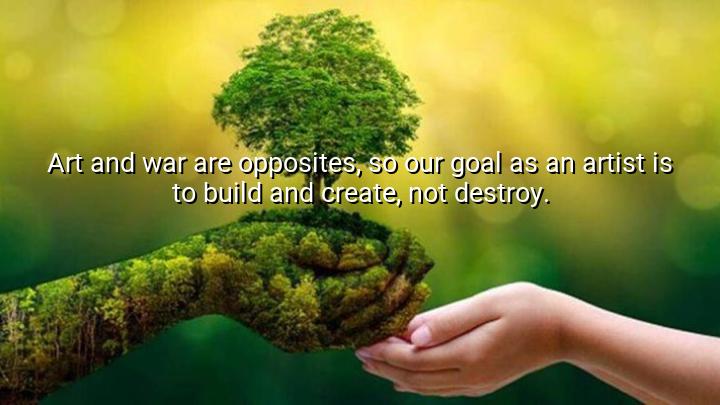




Sergei Polunin’s quote, "Art and war are opposites, so our goal as an artist is to build and create, not destroy," contrasts the fundamental purposes of art and war. Polunin, a renowned dancer, uses this distinction to emphasize the positive and constructive role of art in society. He suggests that while war is about destruction, conflict, and division, art is about creation, expression, and unity. The artist’s role, in his view, is to contribute to the world by building something beautiful and meaningful, not by tearing it down.
By labeling art and war as opposites, Polunin draws attention to the inherent contradiction between the goals of the two. War, whether literal or metaphorical, often leads to harm, loss, and devastation, whereas art seeks to offer solutions, foster understanding, and heal. The creative process in art, whether through dance, music, painting, or any other medium, is about finding ways to express, inspire, and connect rather than to divide or harm.
Polunin’s message also speaks to the broader social responsibility of artists. He implies that artists should actively contribute to creating a better world by focusing on constructive endeavors. Whether through emotional healing, social commentary, or intellectual exploration, artists have the power to build bridges and foster dialogue, offering hope and beauty to counter the destruction caused by conflict and adversity.
Ultimately, Polunin’s quote encourages artists to remain focused on the positive impact of their craft. While war may dominate certain aspects of human existence, art serves as a tool for transcendence, building a world that values creation, compassion, and growth over destruction. It is a call for artists to prioritize the construction of something meaningful, embracing the transformative power of art to shape a more harmonious world.

HPhuong pham
I love this idea, but it does bring up a philosophical tension. Can an artist truly avoid destruction if their work challenges, disrupts, or even offends? Some of the greatest art has been controversial or rebellious, tearing down old ideas to make way for the new. Is that destruction, or still creation? I think it depends on how we define those terms, and whether the outcome adds or subtracts from human understanding.
TQTran Quyen
Reading this made me wonder—if art and war are opposites, then is creating art an act of peace in itself? It feels a bit romanticized, but also deeply motivating. In a time when conflict seems ever-present, the idea that creativity could be a form of resistance is powerful. Do you think all artists are aware of this role they might be playing, or is it often subconscious?
YHYen Hoang
The contrast drawn here is powerful and necessary. Artists have a responsibility, in a way, to bring light where there’s darkness. But that also raises a question: how should artists engage with war or violence in their subject matter? Is it enough to just avoid destructive imagery, or is it sometimes important to confront it head-on to inspire change or reflection? This quote feels idealistic, but maybe that’s exactly what we need more of.
DMDoan Van Duc Minh
I appreciate this perspective, especially in a world that often feels overwhelmed by violence. Art can absolutely be a healing, constructive force. But I do wonder—what about political art or protest art? Sometimes artists aim to dismantle institutions or beliefs. Is that destructive or transformative? Can we draw a clear moral line between art and war, or is there a spectrum where intentions matter more than methods?
HNHanh Nguyen
It’s an inspiring sentiment, but is it always true that artists only build and create? Some forms of art intentionally deconstruct norms or challenge systems in ways that might feel destructive. Can destruction be a form of creative rebirth? Or is that just a semantic twist? I'm curious how artists who deal with dark or violent themes see their role—are they still 'building' through honest representation of chaos?