

Art and literature should help us to get out of our mental cocoons.
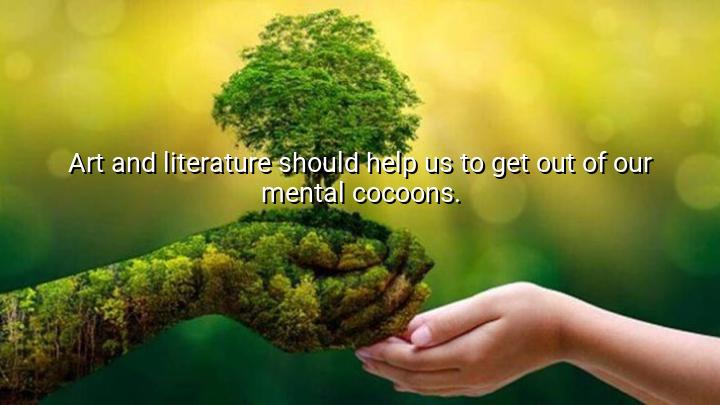




Elif Shafak’s quote, "Art and literature should help us to get out of our mental cocoons," emphasizes the role of art and literature in broadening our perspectives and challenging the limits of our understanding. Shafak suggests that much like the process of a cocoon turning into a butterfly, art and literature have the power to transform our thoughts and break us free from the constraints of narrow, confined thinking. They serve as tools for expansion—opening our minds to new ideas, cultures, and experiences.
The phrase "mental cocoons" refers to the mental state in which individuals may be trapped, limited by their own preconceived notions, biases, or lack of exposure to diverse ideas. These cocoons represent a kind of intellectual or emotional isolation that can prevent us from seeing beyond our immediate surroundings or experiences. Shafak argues that art and literature act as bridges, allowing us to step out of our mental isolation and view the world from different perspectives.
In this context, Shafak underscores the transformative power of art and literature to foster empathy, understanding, and self-awareness. She believes that by engaging with diverse artistic and literary works, individuals can challenge their own assumptions and gain a broader, more nuanced view of the world. This process of intellectual and emotional growth encourages openness and curiosity, which are essential for personal development and societal progress.
Ultimately, Shafak’s quote highlights the importance of creativity in breaking down barriers—both internal and external. Art and literature, she suggests, are not just forms of entertainment or escapism, but powerful instruments for growth and enlightenment. They offer us opportunities to step outside of ourselves, explore new ideas, and connect with others in ways that enrich our understanding of both ourselves and the world around us.

VTDinh Van Tam
Safak’s quote makes me think about how art should be more than escapism—it should be a bridge to the unfamiliar. But I wonder, do creators always intend for their work to challenge perceptions, or does that happen as a byproduct? Also, how much responsibility should artists carry in helping society evolve intellectually or emotionally? It’s a beautiful idea, but I’m not sure how consciously it’s practiced in mainstream creative spaces.
LAthan le anh
What I like about this quote is that it places responsibility on the audience, not just the artist. It assumes we can and should grow from what we consume. But do people really want to escape their cocoons? Or do we mostly use art as comfort, not challenge? I'd be interested in examples of literature that helped people shift long-held beliefs or see the world from a radically different angle.
HPHP PHOTOCOPY
This quote feels like a gentle call to be brave—to explore ideas and cultures we might otherwise ignore. But what happens when the art or literature that helps someone emerge from a 'cocoon' feels threatening or offensive to someone else? Is there a balance between exposure and sensitivity? I'm interested in how creators and audiences navigate that fine line while still fostering genuine growth and understanding.
DHLe Dang Huan
I completely agree with the sentiment, but I’m curious—can all art really pull us out of our mental cocoons? Or is some of it so abstract or self-referential that it ends up reinforcing those very cocoons? What distinguishes transformative art from insular art? I think this quote could start a great conversation about how intent and audience play a role in making art truly eye-opening.
KHKhanh huyen
This quote hits me hard as someone who often gets trapped in routine thinking. It makes me wonder: do we approach literature with the openness it deserves, or are we subconsciously curating what we read to stay comfortable? How can schools and libraries better expose people to diverse stories that push our mental boundaries? I’d love a list of books or artists that have genuinely shifted someone’s worldview.