

All art is but imitation of nature.
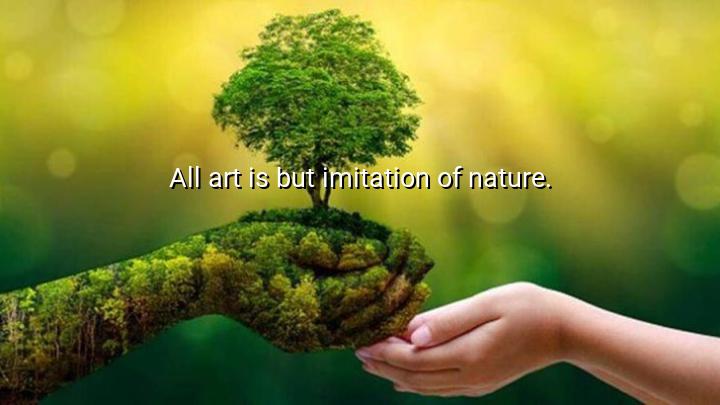




The quote "All art is but imitation of nature" by Lucius Annaeus Seneca expresses the idea that art is fundamentally a reflection or reproduction of the natural world. Seneca suggests that the creative process involves capturing the beauty, forms, and dynamics of nature in a way that mimics or represents reality. Whether through painting, sculpture, or literature, art serves as a medium for artists to replicate and interpret the world around them.
In this context, imitation is not merely about copying nature but about understanding and conveying its essence. Art draws from the natural world as a source of inspiration, seeking to replicate its structures, colors, and emotions. By doing so, art allows humans to engage with nature on a deeper level, interpreting its patterns and meaning through the artist's unique perspective.
The origin of this quote lies in Seneca's Stoic philosophy, which often emphasized the importance of nature as a guide for human behavior and creativity. As a Stoic philosopher and playwright, Seneca saw nature as a harmonious and rational force, and art as a way of capturing and reflecting that order. For him, the artist's role was to imitate the natural world, as it contained the fundamental truths of existence.
By stating that "all art is but imitation of nature," Seneca highlights the deep connection between human creativity and the world around us. This perspective suggests that no matter how abstract or innovative an artwork may appear, it always has its roots in the natural world, serving as a bridge between the physical reality and the artist’s imaginative vision.

VAKiet Vu Anh
Is imitation really all that art does? That feels like it undercuts the emotional and symbolic dimensions of creative work. Nature doesn’t express irony, sorrow, or cultural commentary—humans do. So while nature may inspire, can we really say that protest art or political satire is just imitation? I think there's more going on in art than just mimicking the external world. This quote seems poetic, but maybe not comprehensive.
DNDang Ngo
This quote makes me think about the role of AI in art. If machines generate images or music based on data and patterns, are they also imitating nature, just in a more abstract way? Can a non-human entity engage in this type of imitation? Seneca obviously couldn’t have predicted digital creation, but his idea raises interesting questions about what counts as 'natural' in a world where technology is so deeply integrated.
PTPhuong Thuy
If all art is an imitation of nature, does that mean nature is the only true original? That idea is kind of humbling. It implies that no matter how innovative we think we are, we’re always drawing from something that already exists. But where does that leave art that seems to come from inner experience, like dreams or imagination? Is that just a different layer of nature—or something entirely separate?
TNNguyen Thi Thuy Nhung
Reading this makes me think about how often artists talk about 'capturing the essence' of something. Maybe that’s what Seneca’s getting at—not copying nature, but interpreting its rhythms, emotions, or energy. But in that case, doesn’t calling it 'imitation' oversimplify the artistic process? I’d love to hear how modern artists or philosophers interpret this—especially those working with digital media, where nature isn't always a reference point.
TAluu thanh an
I find this idea both elegant and a little limiting. On one hand, nature is the most profound source of inspiration—its colors, patterns, and complexity are endlessly rich. But on the other hand, what about abstract or conceptual art that doesn’t seem to reference nature at all? Can something completely non-representational still fall under this definition? Or is Seneca’s quote more metaphorical than literal?