

All art is autobiographical. The pearl is the oyster's autobiography.
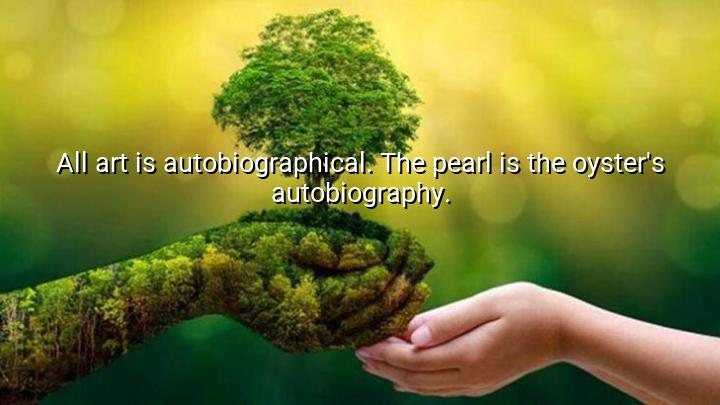




The quote "All art is autobiographical. The pearl is the oyster's autobiography" by Federico Fellini suggests that art reflects the personal experiences, emotions, and identities of the artist. Fellini implies that even when an artist creates something seemingly unrelated to their personal life, it is still a form of self-expression, as their work is shaped by their perspective, thoughts, and history. Just as an oyster creates a pearl as a response to an internal process, art emerges from the internal world of the artist, offering a glimpse into their soul.
In this context, autobiographical means that the essence of the artist is embedded in their art, regardless of the subject matter. The process of creation, the choices made, and the emotions conveyed all reflect aspects of the artist's identity, experiences, and worldview. Fellini’s use of the pearl and oyster metaphor highlights how art can be seen as a product of an internal, personal journey, where the external form is shaped by something deeper and more intimate.
The origin of this quote comes from Fellini’s own perspective as a filmmaker, known for his deeply personal and surreal storytelling. In works like 8½ and La Dolce Vita, Fellini often explored themes of self-reflection, identity, and the human condition. His films were not just narratives but also meditations on his own experiences, dreams, and emotions, reinforcing the idea that art is an expression of the artist’s inner world.
By stating that "All art is autobiographical," Fellini suggests that art serves as a window into the artist's life and inner landscape. The pearl metaphor further emphasizes the organic, personal nature of creation, suggesting that just as the oyster produces the pearl through an internal process, the artist produces art as a reflection of their own journey, struggles, and self-discovery. Art, in this sense, is never just a product but a living, evolving expression of the artist's life and essence.

LTLac Tu
There’s something both beautiful and heavy in this quote. It suggests that every piece of art is a reflection of the artist’s inner life, which feels intimate and maybe even vulnerable. But that also raises the question: does every artist want to reveal themselves through their work? Can someone create meaningful art while protecting their privacy? I think there’s a balance between exposure and expression that each artist has to navigate.
MNMinh Nhat
I love this quote because it redefines autobiography in such a lyrical way. Instead of thinking of it as a literal account, it becomes something metaphorical and deeply personal—like a hidden signature. But I wonder how this idea applies to commercial or commissioned work. Can something created for a client or audience still reflect the artist’s true self? Or does it lose some of that autobiographical quality under external direction?
KLTran Khanh Linh
The quote makes me reflect on the emotional residue in creative work. Even the most fantastical or fictional art seems to echo the artist’s inner world. But what about collaborative art—like film, theater, or music bands? If many voices are involved, is the result still autobiographical? Whose story is being told, and how do we untangle those layers? It’s a fascinating thought when considering large-scale or co-created projects.
PNha phuong nguyen
This quote challenges the belief that art can ever be fully detached from its creator. But does that mean interpretation should always consider the artist’s personal story? Or can a work of art be appreciated and understood without any knowledge of the person behind it? I’m curious about how much the artist’s biography should influence our understanding of their work. Should it be essential, optional, or even irrelevant?
MTmai thanh
Fellini's metaphor really resonates with me. The idea that something beautiful is born from a wound or irritation feels incredibly true, especially in art. But it also makes me wonder—does that mean art must come from pain or struggle to be meaningful? Can joy or ordinary experiences be just as autobiographical? I think there's a danger in romanticizing suffering as the only source of authentic artistic expression.