

A writer should write with his eyes and a painter paint with his ears.
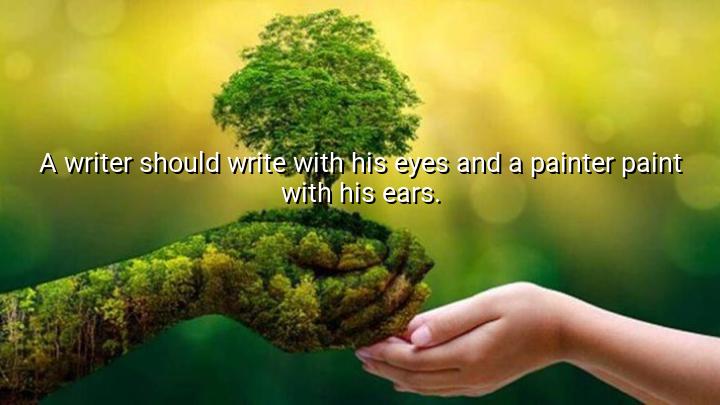




The quote "A writer should write with his eyes and a painter paint with his ears" by Gertrude Stein offers a thought-provoking reflection on the nature of artistic expression and the different ways that writers and painters engage with the world. Stein suggests that writers, while creating stories or essays, should use their eyes to observe the world around them, capturing the details and nuances of what they see. For painters, however, the act of creation is less about visual representation and more about capturing the emotional or sensory experience, which she compares to listening—using their ears to attune to the rhythms, sounds, and feelings that inform their work.
Stein's perspective suggests that writing and painting involve different modes of perception. While a writer may focus on visual details, a painter should go beyond what is simply seen and instead engage with a deeper, more intuitive level of perception. The idea of painting with the ears implies that art should not just be about physical observation, but about capturing the essence of a subject, much like a musician captures sound. This could also hint at the importance of imagination and abstract thinking in the creative process, where the artist must go beyond the literal to express a fuller, more emotional experience.
The quote also underscores the sensory nature of both writing and painting. Stein’s suggestion to write with the eyes may be seen as an invitation to use observation as a tool for crafting vivid, detailed imagery, whereas painting with the ears encourages painters to interpret the world in ways that involve emotional and auditory responses, rather than just visual. Both forms of art require a deep, almost instinctual connection to the world and a willingness to explore and express it through unique senses.
In essence, Stein’s quote challenges traditional ideas of how writers and painters should engage with their craft. It emphasizes that while writing is often tied to what we see, painting is about translating something beyond the visual—a call for artists to listen and experience their surroundings on a more profound, sensory level.

HDHiep Dinh
Gertrude Stein’s line is such a rich challenge to conventional thinking. I interpret it as a reminder that creators shouldn't be boxed in by discipline-specific norms. Painters don’t just see—they hear the world, absorb its rhythm. Writers don’t just hear—they must observe closely. Could this imply that the truest art arises from blending perception modes? If so, should artists consciously cultivate these cross-sensory experiences to enhance their work?
MLMy Le
At first glance, this quote almost seems nonsensical, but when I think about it more, it really emphasizes the importance of cross-sensory awareness. Could this be a metaphor for artists tapping into more intuitive, less literal forms of perception? It makes me wonder—are the best works those that defy logic and engage senses in unexpected ways? Have you ever encountered art that made you feel this kind of synesthetic connection?
TNTram Ngoc
This statement is so paradoxical and yet oddly resonant. It makes me wonder—how much does this play on the senses relate to the surrealist movement or the abstract artists of Stein's time? Could it also be a commentary on how artists shouldn’t rely solely on the obvious tools of their trade? Like maybe writers shouldn’t just look, but deeply feel, and painters shouldn’t just see, but listen to the world around them.
MHTrinh My Hanh
Stein’s quote really intrigues me—could she be pointing to the idea that great art comes from empathy or deep listening? I wonder if she meant that writers should observe the world visually while painters should be attuned to rhythm, tone, and atmosphere, almost like music. It makes me question how artists develop their sensitivity to the world. Is this kind of sensory crossover something artists train themselves to do?
PVMuoi Pham Van
This quote feels like a poetic puzzle. What could it mean for a painter to paint with their ears? Is Stein suggesting that art should be multi-sensory, or that creators need to draw from beyond the obvious? I love how it challenges us to think about perception in unconventional ways. Do you think this is about blending disciplines—like synesthesia—or is it metaphorical, about being receptive to inspiration from unlikely sources?