

A work of art is the unique result of a unique temperament.
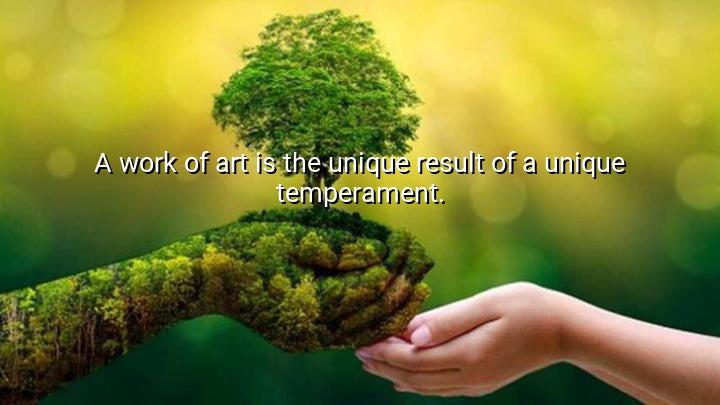




The quote "A work of art is the unique result of a unique temperament" by Oscar Wilde emphasizes the deeply personal and individual nature of artistic creation. Wilde suggests that every work of art reflects the distinctive personality, emotions, and perspective of the artist. The temperament of the creator—shaped by their experiences, thoughts, and emotional responses—imbues the art with a uniqueness that cannot be replicated. This highlights the idea that art is not just about technique or skill, but about the individual vision and character of the artist.
In this context, temperament refers to the artist’s inherent traits, personality, and emotional state, which shape how they approach their craft. Wilde is stating that no two artists can produce the same art because each artist’s temperament is different, influencing the creation process and the final outcome. This reinforces the idea that art is an expression of the self, where the artist's identity is woven into the fabric of their work.
The origin of this quote can be traced to Wilde's broader philosophy on art and creativity, which often celebrated individualism and the power of personal expression. As a writer and playwright known for his wit and critique of social norms, Wilde viewed art as an expression of the artist’s unique qualities. His works, such as The Picture of Dorian Gray and The Importance of Being Earnest, often explored the complexity of human nature, individual desires, and societal influences, which align with his belief that art is inherently personal.
By stating that "A work of art is the unique result of a unique temperament," Wilde underscores the idea that true art is an extension of the artist’s individual self. It is through the artist’s temperament, their emotional and intellectual makeup, that they create something that is distinctly their own. This perspective elevates art beyond technique, making it a deeply personal, expressive, and transformative endeavor.

TBT bady
This quote makes me reflect on how society judges art. If every work reflects a unique temperament, should we stop trying to rank or compare them against one another? Maybe art criticism becomes less about what’s good or bad and more about understanding different psyches. That could be liberating—but also a little chaotic. Would removing objective standards help or hurt how we engage with creative work?
LNLan Nguyen
There’s an almost romantic idealism in this quote, as if art is more a product of character than discipline. It makes me think—do we value the artwork more because of the personality behind it, or should the piece stand independently of its creator? Especially now, when people debate separating the art from the artist, Wilde’s statement feels even more complicated. What are we really admiring—the work or the person?
QTHai Quynh Tran
This strikes me as a comforting thought for anyone who struggles with imposter syndrome in the arts. If your temperament itself is the key to your art’s uniqueness, then maybe the best thing you can do is be honest about who you are. But I’m curious—can someone cultivate a temperament that’s more ‘artistic,’ or is it something you’re born with? Where does individuality end and craft begin?
Ttuan
Oscar Wilde’s perspective really highlights the personal nature of artistic expression. But how does this fit in with collaborative art forms, like film or architecture? If a work is shaped by many people’s temperaments, does it lose that 'unique' aspect? Or do we simply experience a new kind of uniqueness—one that's more complex because it's built from multiple emotional palettes?
Ttrung
This quote makes me wonder about the relationship between personality and creative output. Does every piece of art inevitably carry the emotional fingerprint of its creator, even if the artist tries to suppress it? And if so, does that mean truly great art can’t be replicated because it’s tied to one person’s inner chemistry? That idea feels both inspiring and limiting—how much does talent depend on temperament rather than skill?