

A picture is a poem without words.
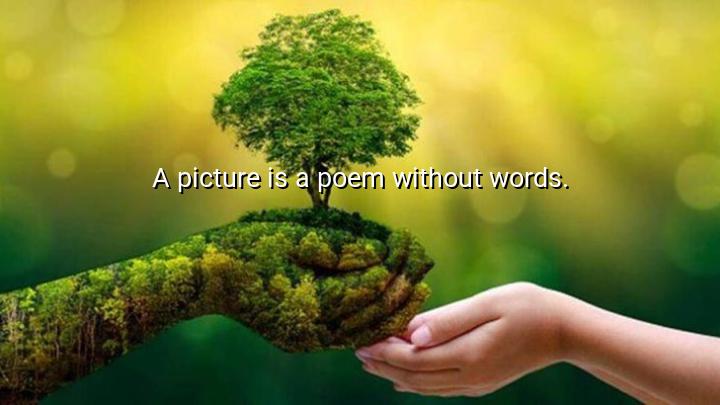




The quote "A picture is a poem without words" by Horace emphasizes the power of visual art to convey emotions, ideas, and stories in a way that transcends verbal language. Horace, an ancient Roman poet, compares the picture to a poem, suggesting that both art forms express deeper meanings and evoke emotions, but while a poem uses words to do so, a picture relies on visual elements like color, composition, and form. This comparison highlights the artistic depth and expressive potential of both mediums.
In this context, Horace suggests that a picture, much like a poem, can tell a story or express complex thoughts without the need for language. Just as a poem uses words to paint vivid pictures in the mind, a picture uses visual language to evoke similar responses from the viewer. The absence of words in visual art allows the viewer to interpret the image in their own way, just as readers interpret a poem through personal understanding and imagination.
Horace’s quote also speaks to the universal nature of art. A picture, like a poem, can communicate across languages and cultures, making it accessible to a broader audience. The emotions and themes expressed through the image or the written word can resonate with people from different backgrounds, suggesting that both forms have the power to transcend language barriers and connect individuals on a deeper, more universal level.
Ultimately, this quote underscores the timeless connection between visual art and poetry, showing that both have the ability to express profound truths, emotions, and ideas without the need for literal language. Through pictures and poems, the artist or poet invites the audience to experience a shared moment, offering a language of the heart that speaks directly to the soul.

MPMaichay Phaiphai
This quote makes me reflect on the power of visual art and its ability to evoke emotions without the use of language. Is it possible that pictures are more potent because they don't need explanations? When we view a painting, do we bring our own experiences, memories, and emotions into the interpretation, making each encounter with the artwork unique? Could it be that the strength of a picture lies in what it leaves unsaid?
TNTrang Nguyen
It’s intriguing to think about how a picture can communicate a message without saying anything at all. Does that mean that images, like poetry, are open to interpretation and reflection? When we look at a picture, do we read it the way we read a poem—searching for deeper meanings, emotions, or hidden messages? What is it about visual storytelling that resonates with us on a different level than written or spoken words?
DALe Duc Anh
I find this quote interesting because it suggests that both poetry and visual art are forms of storytelling, each in its own unique way. In some ways, visual art can be more immediate, less structured than poetry. Does this mean that art like paintings or photographs is more accessible to people who struggle with reading or writing? In a way, is a picture more universal than a poem because it transcends language barriers?
ATBui anh thu
I’m curious if everyone would interpret a picture in the same way, just like we all interpret poetry differently. What if a picture speaks to one person in a way that’s totally different from someone else’s experience of the same image? Could the absence of words leave too much room for subjective interpretation? Or, does that open up possibilities for people to connect with the artwork more deeply than they might through a direct narrative?
TABui Thi Anh
Horace’s comparison between pictures and poems got me thinking: can visual art be as powerful as poetry? Poems often rely on imagination, metaphors, and emotions. Do pictures do the same thing? How do we interpret a painting without words to guide us? Does this mean that visual art communicates universally, or is it more personal, relying on individual perspectives and experiences to make sense of the imagery?