

A great artist can paint a great picture on a small canvas.
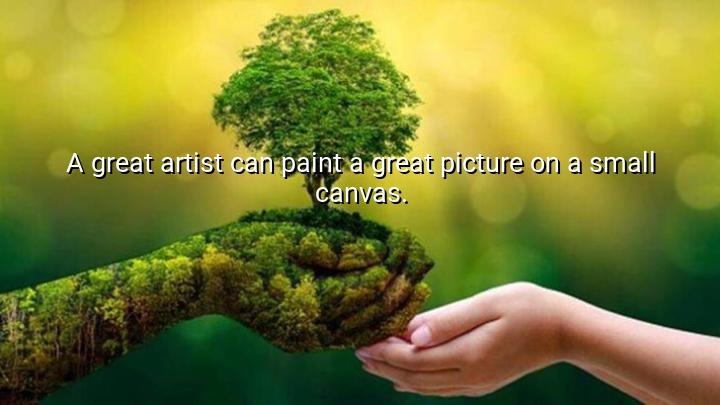




The quote "A great artist can paint a great picture on a small canvas" by Charles Dudley Warner emphasizes that the true measure of an artist's ability lies not in the size or scope of the work, but in the skill and depth they bring to it. Warner suggests that a great artist is capable of creating something extraordinary, even within the limitations of a small canvas. This highlights the idea that art is not defined by its scale, but by the creativity, vision, and technique of the creator.
In this context, the canvas is symbolic of the medium or the space available to the artist. The quote implies that an artist’s talent is not constrained by the physical limitations of their work. Whether working on a large, expansive canvas or a small, confined one, the great artist can still produce a powerful, meaningful picture. The value of the work lies in how the artist engages with their materials and ideas, not the size of the canvas they work on.
The origin of this quote reflects Warner's view on creativity and artistry, emphasizing the importance of skill and artistic expression over external factors like size or material. Warner was a prominent American writer and critic, known for his insightful observations on various topics, including literature and art. His perspective on art aligns with the idea that greatness in creation comes from the artist’s ability to work within whatever constraints they are given.
By stating that "A great artist can paint a great picture on a small canvas," Warner encourages us to recognize the potential for greatness in all forms of art, regardless of size or scope. It is a reminder that quality and impact are not determined by the scale of the work but by the artist's ability to infuse their creation with meaning, emotion, and skill.

TQNguyen Thi Quyen
There's something deeply egalitarian in this statement. It seems to argue that talent shines regardless of circumstances. In a world obsessed with access to tools, technology, and space, this is refreshing. But is it also overly idealistic? Can we always expect artists to do more with less? Maybe the real message here is about intention and precision—choosing every stroke carefully because there’s no room for waste on a small canvas.
HDHuong Do
I like the philosophical feel of this quote. It’s almost a challenge: can you express something profound with very little? But I also wonder—does this underestimate the power of scale in creating immersive experiences? Some pieces are meant to be grand because their message needs that space. So, while I agree with Warner, I also think that sometimes a big canvas isn’t just indulgent—it’s essential. What do others think?
HThue tran
This resonates with me as a reminder that quality and depth aren't tied to physical scale. However, it also raises questions about the role of ambition in art. Should artists intentionally choose smaller canvases to prove their mastery? Or is this more about being adaptable and capable, regardless of the conditions? Sometimes I wonder if too many tools and space actually dilute the artistic vision rather than focus it.
DTChi Py De Thuong
I find this quote incredibly empowering. It reminds me that even with limited means or a small platform, one can still create something impactful. But then I wonder—how does this idea apply outside of painting? Could it apply to writing, music, or even entrepreneurship? Is it always about the size of the medium or the depth of the message? There’s something beautifully humble in the thought that greatness doesn’t need grandeur.
KTnguyen pham khanh thuan
This quote really makes me think about limitations and how they might actually enhance creativity. Is Warner suggesting that true artistic skill isn't dependent on grand resources or expansive space? If so, I wonder how much of modern art's focus on scale and spectacle is necessary. Are we valuing size over substance? I'd love to hear examples where constraints led to greater artistic breakthroughs rather than hindrances.