

A beautiful body perishes, but a work of art dies not.
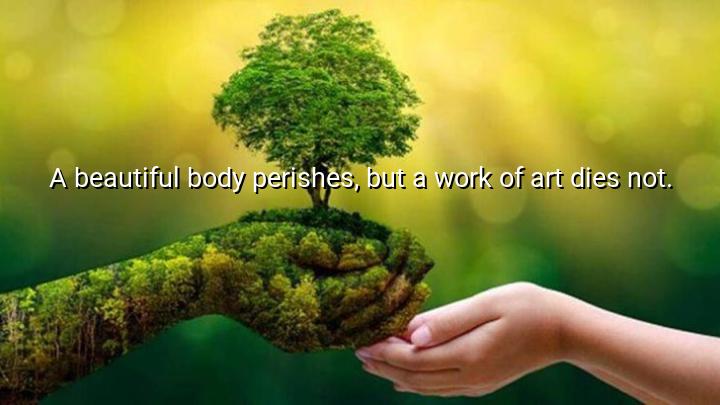




The quote "A beautiful body perishes, but a work of art dies not" by Leonardo da Vinci reflects the enduring nature of creativity and artistic achievement. Da Vinci emphasizes that while the physical form, no matter how beautiful, is temporary and fades with time, art has the power to transcend mortality. A piece of art—whether painting, sculpture, or music—can live on, far beyond the physical lifespan of the artist or the subject.
This quote likely stems from da Vinci’s deep appreciation for art and nature. As an artist and a scientist, he saw the intricate beauty in both the human body and the world around him. However, he understood that while human beauty is fleeting, the products of human ingenuity and creativity have an enduring legacy. In this sense, da Vinci may have been alluding to the immortality of his own art, such as the Mona Lisa, which continues to captivate audiences centuries after its creation.
Da Vinci’s reflection also touches on a philosophical notion about the preservation of human accomplishment. While a person’s physical form is subject to decay, their artistic works—imbued with thought, emotion, and creativity—remain as a testament to their vision and spirit. Art can inspire and connect generations, transcending the boundaries of time and place, allowing the creator to live on in the hearts of those who experience their work.
In essence, this quote serves as a reminder of the immortality of creative expression. It highlights that the true value of a person is not in their physical beauty, which is bound to fade, but in the timeless impact of their artistic legacy.

TNNguyen Ngoc Thien Nhan
Reading this makes me think about how art serves as a time capsule. Even as bodies fade and generations pass, we still look to old paintings, sculptures, and stories for understanding. But is it fair to say that art never dies? What about works that are lost, censored, or destroyed? Is the spirit of the piece enough to count as living on, or does survival depend on preservation and memory?
TKNguyen tuan kiet
This quote speaks to the human desire to leave a mark that endures beyond our own life. I think da Vinci understood the power of expression over appearance. It makes me wonder how much of modern society is focused on preserving beauty rather than creating meaning. Do we put enough emphasis on creating lasting works, or are we too distracted by the pursuit of the temporary?
TNtuyen Nguyen
I find this quote poetic, but I’m curious—do you think all art achieves this kind of immortality? Or only the art that connects deeply with people? There’s so much being created all the time, but only some works become part of cultural memory. What factors actually make a work of art live on? Is it about quality, timing, audience, or something else entirely?
TDNGUYEN THUY DIEM
There’s something profoundly reassuring in this quote, especially for creatives. It suggests that our artistic efforts outlast our physical selves, which is kind of comforting. But I do wonder—how does this hold up in a world where so much art is ephemeral or meant to be temporary, like street art or performance? Can something impermanent still be immortal in the way da Vinci describes?
TDDang Thi Thuy Duong
I feel a bit conflicted about this quote. On one hand, it beautifully elevates art as a lasting imprint of humanity. But on the other hand, doesn’t it risk undervaluing the significance of human life and physical beauty, even if they’re fleeting? Can’t both the body and art be seen as valuable, albeit in different ways? I wonder if da Vinci was speaking more about legacy than comparison.