

You're only lonely if you're not there for you.
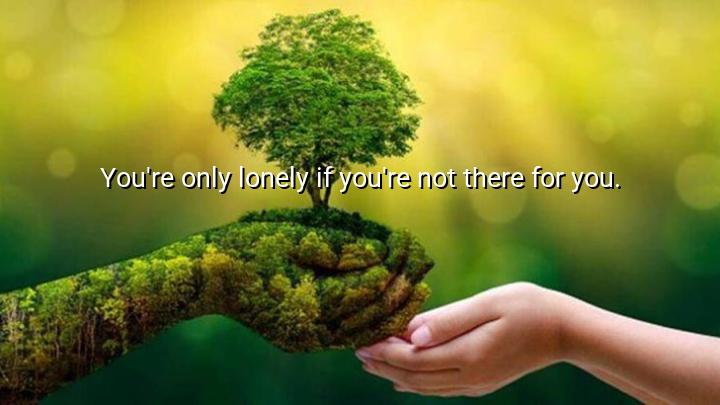




The quote "You're only lonely if you're not there for you" by Phil McGraw—better known as Dr. Phil—emphasizes the importance of self-support and emotional self-reliance. McGraw is pointing out that loneliness doesn’t always come from a lack of others, but often from a lack of connection with oneself. If you are present for your own needs, thoughts, and feelings, then even in solitude, you can feel whole and fulfilled.
As a well-known television personality, psychologist, and author, Dr. Phil has often offered practical advice rooted in psychology and personal responsibility. This quote reflects one of his recurring messages: that emotional well-being begins with learning to care for yourself, rather than relying solely on others for validation or companionship. It encourages building a healthy inner dialogue and cultivating a strong sense of self.
The phrase "not there for you" refers to the way people often abandon their own emotional needs, neglecting self-compassion, self-respect, or self-awareness. When we fail to show up for ourselves—whether by ignoring our feelings, harshly criticizing ourselves, or seeking approval externally—we create a sense of emptiness that can feel like loneliness, even in a crowded room.
Ultimately, Dr. Phil’s quote reminds us that the foundation for overcoming loneliness is a solid relationship with the self. When we learn to be our own support system, we become less dependent on others to fill emotional gaps. True companionship, then, begins within—and once that’s established, we’re better equipped to form meaningful and balanced connections with the world around us.

DHvu duc hoan
It’s an interesting take — and it kind of flips the script. Usually, we associate loneliness with being physically or emotionally without others, but this quote suggests the deeper issue is self-disconnection. Do you think people who truly like themselves experience loneliness differently, or maybe less intensely? That’s something I’ve never really considered until now, and it opens up a new way of thinking about solitude and self-worth.
HLHong Lan
This quote is really making me examine how often I abandon myself emotionally when I’m upset or lonely. Instead of comforting myself, I sometimes get critical or numb. Is learning to be emotionally available to ourselves the foundation of emotional resilience? If so, why isn’t this taught more widely? It feels like one of the most important life skills no one talks about.
HNHuynh Nhu
I appreciate the idea behind this quote, but I wonder if it assumes everyone has the emotional tools to support themselves. For people who grew up without that kind of internal support modeled, being there for themselves might not come naturally. Should we talk more about how to develop that inner presence — like through therapy, mindfulness, or journaling — instead of just expecting it to exist?
KTNguyen Thi Kieu Trang
This quote makes me reflect on how often we seek comfort or validation externally instead of nurturing ourselves. But what does it actually mean to be there for yourself? Is it about practicing self-compassion, setting boundaries, or simply accepting your own feelings without judgment? I’d love to hear how others interpret the idea of ‘being there’ for yourself in practical terms.
Hhung
I find this quote empowering but also a little reductive. It makes it sound like all loneliness can be solved through self-love, which might not be the case for everyone. What about people dealing with isolation due to loss, mental health, or discrimination? Can we always 'show up' for ourselves when life gets heavy? I like the message, but I think it needs more nuance.