

With fools, there is no companionship. Rather than to live with men who are selfish, vain, quarrelsome, and obstinate, let a man walk alone.
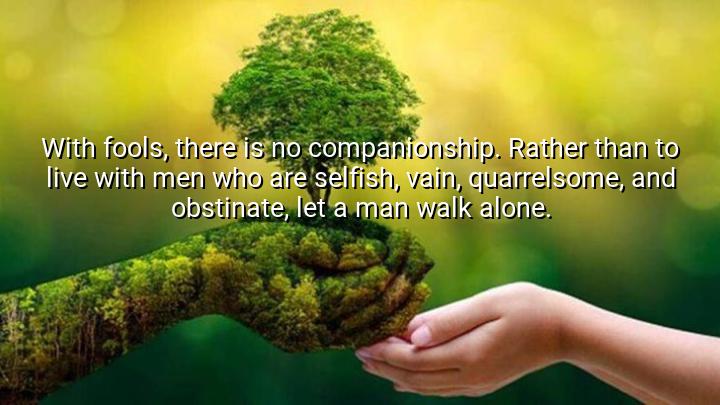




In this quote, Buddha emphasizes the importance of companionship and the impact of surrounding oneself with the right kind of people. He states that living among fools, or individuals who are selfish, vain, quarrelsome, and obstinate, offers no true companionship. Buddha suggests that it is far better to live in solitude than to spend time with people who possess negative traits that prevent meaningful connection and growth.
Buddha's words reflect his belief in the value of positive relationships that contribute to personal growth and inner peace. People who are selfish and quarrelsome disrupt one's mental and emotional well-being, as their behavior fosters conflict and negativity. Buddha advises that a person should choose solitude over toxic companionship, as being alone can be more peaceful and conducive to spiritual development than being surrounded by harmful influences.
This perspective aligns with Buddha's teachings on the importance of detachment and the avoidance of unhealthy relationships. Buddha believed that one’s spiritual journey and pursuit of inner peace could be hindered by the wrong kind of social environment. He advocates for walking alone when necessary, as it allows a person to focus on their own growth without the distractions or negativity that come from difficult relationships.
Ultimately, Buddha’s quote serves as a reminder of the value of surrounding oneself with individuals who contribute positively to one’s life. If such people are not present, solitude becomes a better alternative than enduring toxic, destructive relationships. The quote encourages individuals to prioritize peace, mindfulness, and meaningful connections over superficial or harmful companionships.

NBngoc Bao
This quote makes me think about the trade-offs of solitude versus companionship. Is this advocating for complete withdrawal, or simply urging mindful selection of friends? I wonder if this is more about cultivating inner peace than actually being alone. Can solitude in a noisy world be more beneficial than togetherness filled with conflict? If so, how do we embrace solitude without feeling abandoned or lonely?
DQDAO NGOC DIEU QUYEN
There’s strength in the message, but also a quiet sadness. Is it suggesting that being surrounded by flawed individuals is worse than being alone? Humans are inherently imperfect—so where do we draw the line between tolerable flaws and toxic traits? This quote makes me question whether I'm too tolerant or not discerning enough in my relationships. How do we develop that wisdom without becoming isolated or overly critical?
TTThu thuy
I totally understand the desire to avoid selfish and quarrelsome people, but what if they’re family or coworkers—people you can’t just walk away from? This quote feels idealistic in that regard. How does one apply this teaching practically in situations where escape isn’t possible? Is the answer emotional detachment rather than physical distance? I'd love insight into how Buddhist philosophy navigates these complex social dynamics.
LTNam Luong Thanh
Reading this, I feel both empowered and conflicted. It validates the choice to distance myself from toxic people, but is walking alone always the better option? Isolation can be deeply damaging too. Is this quote more metaphorical, encouraging self-reliance, or is it a literal push toward solitude? I’m curious how this aligns with Buddhist ideas of interconnectedness and community. Can solitude be spiritual without becoming antisocial?
K112.Nguyen Tran Anh Kiet 11E
This quote really resonates with me, but I wonder—how do we define who is truly a ‘fool’? Isn’t there a danger in labeling people this way too quickly, especially when personal growth takes time and everyone is flawed? While I see the wisdom in avoiding toxic company, I’m also concerned about the potential for arrogance or judgment. How can we balance discernment with compassion when choosing who to walk with in life?