

To live a pure unselfish life, one must count nothing as one's own in the midst of abundance.
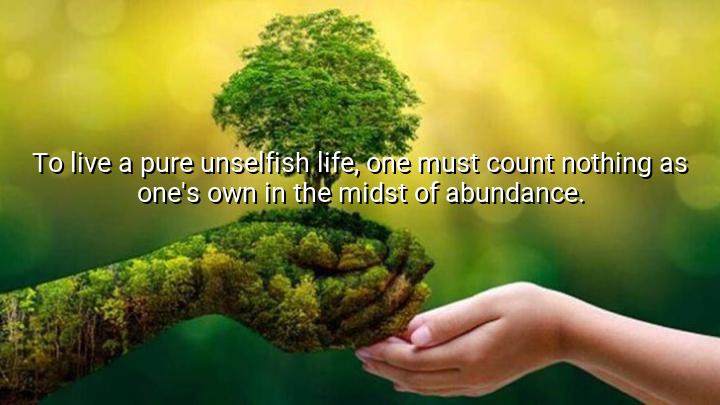




The quote by Buddha, “To live a pure unselfish life, one must count nothing as one's own in the midst of abundance,” emphasizes the importance of detachment and selflessness. It suggests that true purity of life comes not from renouncing the world entirely, but from releasing the sense of ownership and possessiveness, even when surrounded by plenty. By doing so, one cultivates a generous heart and avoids being enslaved by material desires or ego.
Buddha, the founder of Buddhism, often taught about the dangers of attachment and the path toward enlightenment. This quote reflects his belief that abundance, whether in wealth, relationships, or resources, can lead to self-centeredness unless it is approached with mindfulness and equanimity. Living unselfishly allows individuals to act with compassion, wisdom, and moral clarity, rather than being driven by greed or possessiveness.
The origin of the quote lies in Buddha’s teachings on the Middle Way, which advocate a life of balance, generosity, and ethical conduct. By advising that one should not claim ownership even in times of plenty, Buddha underscores the principle that true happiness and freedom come from letting go of attachment, rather than accumulating possessions. This approach encourages inner peace and spiritual growth over material gain.
In essence, the quote serves as a reminder that a selfless life requires mindful detachment and the recognition that possessions do not define us. By releasing the notion of “mine” in the midst of abundance, one nurtures compassion, humility, and generosity, which are essential for a life of meaning and spiritual fulfillment.

AAdministratorAdministrator
Welcome, honored guests. Please leave a comment, we will respond soon