

Who can protest alone? Who dares rise up? It is not easy. One is all alone, and evermore shall be so.
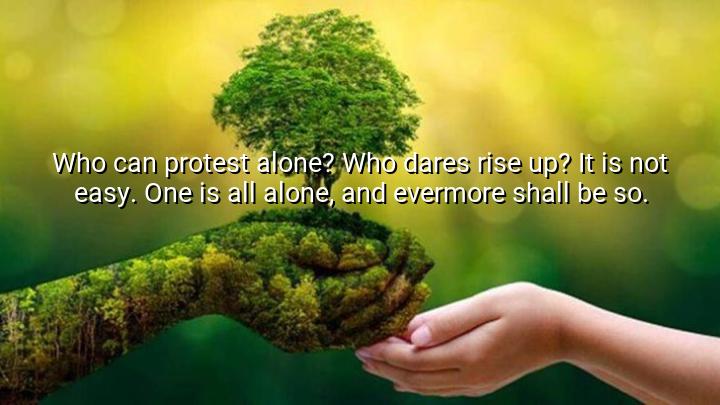




The quote, "Who can protest alone? Who dares rise up? It is not easy. One is all alone, and evermore shall be so," is from Michael Leunig, an Australian cartoonist, poet, and artist known for his philosophical and often introspective works. In this statement, Leunig reflects on the difficulties of standing up for a cause or protesting, particularly when one feels isolated. He emphasizes the personal struggle and the sense of loneliness that often accompanies the act of resistance or challenging the status quo.
Leunig's words explore the idea that taking a stand or speaking out can be an overwhelming and solitary experience. The rhetorical question "Who can protest alone?" suggests that protest requires support and unity, as standing alone against powerful forces can feel daunting and unproductive. Despite this, he acknowledges the reality that sometimes individuals must act alone, even when it feels like an uphill battle.
The phrase "One is all alone, and evermore shall be so" speaks to the emotional toll of resistance, implying that there are moments when people must confront challenges without the comfort of collective support. This highlights the alienation that can come with standing up for what one believes, especially when the individual feels that their efforts are unacknowledged or unsupported by others. The quote touches on the inner conflict between the desire for solidarity and the reality of individual action.
Ultimately, Leunig’s quote reflects on the loneliness that often accompanies standing up for a cause, yet it also captures the human resilience in the face of isolation. It suggests that despite the struggles and sacrifices involved in protesting or rising up, there is a deep, enduring personal strength that comes from acting on one's convictions, even if that means doing so alone.

TBAnh Thu Bui
This quote evokes empathy for those who dare to challenge norms despite loneliness. But I wonder, is solitude in protest always permanent, or can it be temporary until others join? How do modern communication tools change the experience of solitary protest? It seems important to understand both the emotional cost and the potential for transformation in these solitary acts.
VQVinhhh quoc
Leunig’s words raise questions about the nature of dissent. Does being ‘all alone’ in protest imply marginalization or strength? How do social and cultural factors influence whether someone feels isolated or supported in their activism? I’d like to explore historical examples of lone protesters and how their solitude shaped their impact.
DHle dungc hoang
Reading this, I feel the tension between individual bravery and the need for collective action. Is it possible for protest to begin alone but grow into a shared movement? How does one navigate the initial solitude without losing hope or motivation? This quote highlights the emotional weight of being the sole voice in opposition.
UGUser Google
This statement makes me reflect on the courage required to stand alone against prevailing systems. How do people sustain themselves emotionally and mentally when they ‘evermore shall be so’ alone in protest? Could this loneliness be a catalyst for deeper commitment or a deterrent? I’m curious about the role of support networks in mitigating this isolation.
VKnguyen van khanh
Leunig’s quote poignantly captures the loneliness of protest and dissent. I wonder if this sense of isolation is a universal experience for activists or if community can ever fully dissolve that solitude. What drives individuals to take a stand despite the loneliness? Does this quote suggest that true protest is inherently solitary, or is it a call to find solidarity despite the odds?