

While the soul is in mortal sin, nothing can profit it; none of its good works merit an eternal reward, since they do not proceed from God as their first principle, and by Him alone is our virtue real virtue.
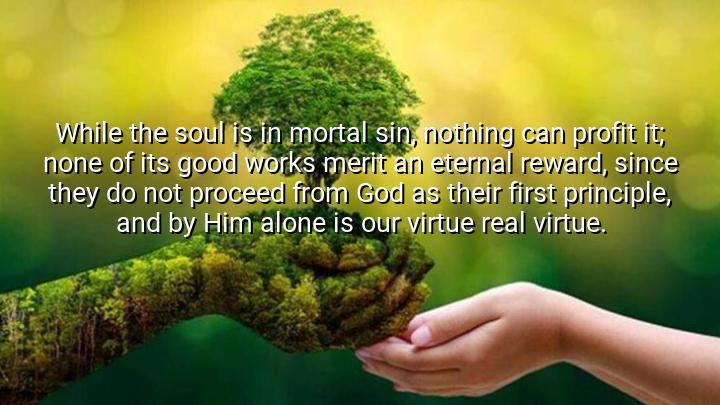




The quote "While the soul is in mortal sin, nothing can profit it; none of its good works merit an eternal reward, since they do not proceed from God as their first principle, and by Him alone is our virtue real virtue." by Saint Teresa of Avila emphasizes the importance of spiritual alignment with God in achieving true virtue and the possibility of eternal reward. Saint Teresa, a Spanish mystic and Carmelite reformer, believed that the soul must be in a state of grace and union with God to carry out good works that are truly meaningful and worthy of eternal reward. If the soul is in mortal sin, any actions performed, no matter how virtuous they seem, cannot lead to salvation or merit eternal life because they are not guided by God.
According to Teresa, mortal sin creates a separation from God, which means that any good deeds performed during this time are disconnected from their true source, which is God. She argues that without divine guidance or the influence of grace, even good works lack the capacity to lead to salvation or earn eternal rewards. The works must be rooted in God’s will and carried out with a heart aligned with His purpose to have true spiritual value.
The statement also points to the idea that virtue, in its truest sense, is not something that comes solely from human effort but must be infused by God. For Teresa, real virtue is not self-generated; it is a gift from God that enables individuals to perform good works in alignment with His will. This underscores the central role of divine grace in leading a life that is pleasing to God and ultimately leads to eternal life.
Ultimately, Teresa’s words highlight the connection between spiritual purity and the moral actions that arise from it. Grace, virtue, and good works are deeply intertwined in her theology, and she teaches that without God's guidance and the state of grace, human actions lack the power to achieve salvation. Her message encourages believers to seek spiritual alignment with God in order to truly live a life of virtue that leads to eternal reward.

TKnguyen trung kien
I’m curious how this teaching impacts the understanding of salvation and forgiveness. Does it imply that mortal sin completely nullifies any spiritual progress until absolution? How might this influence the believer’s sense of hope and motivation? This quote invites reflection on mercy, justice, and the transformative power of faith.
KAnguyen thi kim anh
This quote makes me wonder about the tension between divine sovereignty and human free will. If virtue only exists through God, what role do personal choices and efforts play? How do believers reconcile dependence on divine grace with the responsibility to live morally? It’s a profound theological balance that shapes spiritual practice.
HGnguyen thi ha giang
Could this statement be seen as a call for inner transformation rather than external performance? If good works are insufficient without grace, how does one cultivate that spiritual alignment? It prompts deeper inquiry into the processes of confession, repentance, and sanctification in Catholic spirituality.
UGUser Google
I’m intrigued by the emphasis on God as the ‘first principle’ of virtue. Does this mean that human actions, no matter how good they appear, lack real value without divine inspiration? How might this perspective challenge ideas of moral autonomy and secular ethics? It invites reflection on the relationship between faith, intention, and moral worth.
TNThao Nguyen
Saint Teresa’s quote underscores the belief that true virtue and merit depend on a soul’s alignment with divine will, rather than mere outward actions. It raises questions about the nature of sin and grace—if good works done in a state of mortal sin are ineffective, what does that say about human effort and redemption? How does this influence personal accountability and spiritual growth within her theological framework?