

When the last red man shall have perished from the earth and his memory among the white men shall have become a myth, these shores will swarm with the invisible dead of my tribe. The white man will never be alone. Let him be just and deal kindly with my people, for the dead are not powerless.
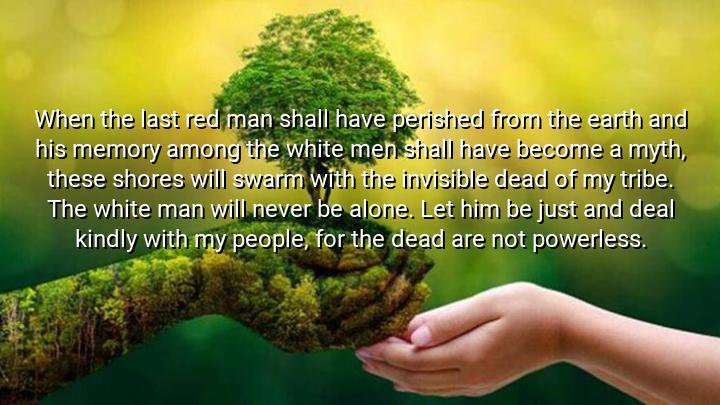




The quote "When the last red man shall have perished from the earth and his memory among the white men shall have become a myth, these shores will swarm with the invisible dead of my tribe. The white man will never be alone. Let him be just and deal kindly with my people, for the dead are not powerless" is attributed to Chief Seattle, a leader of the Suquamish and Duwamish tribes in the Pacific Northwest. The quote reflects Chief Seattle’s deep connection to his people, their land, and the spiritual beliefs that permeated Native American life. It speaks to the legacy of his people and their ongoing presence in the land, even after they have physically passed.
Chief Seattle’s words express the inevitability of the Native American displacement by white settlers, and he foresees a future where his people’s memory fades into myth among the newcomers. However, he also implies that even after the physical extinction of his people, their spirit will persist, and they will haunt the land, in a way, making it impossible for the white man to feel truly alone. This reflects the spirituality of many Native American cultures, where ancestors and the land are seen as interconnected and the spirits of the dead continue to influence the living.
The phrase "the dead are not powerless" serves as a powerful reminder of the spiritual strength of the Native American people. Chief Seattle is warning the settlers that they should treat his people with justice and kindness, for the spirits of the dead hold sway over the land, and their influence is lasting. This speaks to the idea that even in the face of oppression and near extinction, the legacy and spiritual presence of a people cannot be erased.
In essence, Chief Seattle’s quote is a reflection of Native American resilience and the belief in the enduring presence of ancestors. It warns that the consequences of mistreatment or injustice will not end with the physical death of a people but will continue to resonate through time, reminding the settlers of their responsibilities. The quote connects honor, spirituality, and justice, urging future generations to remember and respect the original inhabitants of the land.

NHNguyen Ha
This statement blends poetic beauty with an almost prophetic edge. It’s unsettling to realize how relevant it remains today. The phrase 'let him be just' isn’t just a plea—it’s a command from the past echoing into the present. How do we respond to that kind of spiritual warning in a modern world that often treats history as settled and spirits as superstition? What if we’ve underestimated what still lingers?
QNDinh Quynh Nga
The emotional weight of this quote is profound. It’s not just a lament—it’s a declaration that cultural erasure doesn't equal spiritual extinction. I’m left wondering how often this perspective is ignored in mainstream history. Do we really consider the voices of those who were silenced? And how might the world change if we did? This feels like more than a quote—it feels like a challenge to conscience.
TNNguyen Trong Nhan
This quote evokes a feeling of deep reverence for indigenous culture and its relationship to the land. It also makes me question how we define presence and absence. If the land remembers, if spirits remain, then what responsibilities do settlers carry, even generations later? The idea that 'the dead are not powerless' flips the Western narrative on its head. What would it mean to truly live in awareness of that?
MMTran thi mo mong
Reading this gives me chills. There’s both sorrow and strength in Chief Seattle’s words. The concept of 'the invisible dead' watching over their land is deeply spiritual, and it demands respect. But I wonder—what does justice actually look like in this context? Is it acknowledgment? Reparations? Education? The quote clearly calls for moral accountability, but I’m not sure we’ve fully understood or answered that call even today.
THNguyen Thi Thu Hien
This quote is haunting and incredibly powerful. It blends grief, prophecy, and a deep sense of spiritual continuity. I’m struck by the idea that memory may fade, but presence endures—through land, spirit, and justice. Chief Seattle seems to be warning that history cannot be erased without consequence. It makes me wonder: how should modern society reckon with this legacy? Can we ever truly restore dignity to cultures that have been so deeply wounded?