

When so many are lonely as seem to be lonely, it would be inexcusably selfish to be lonely alone.
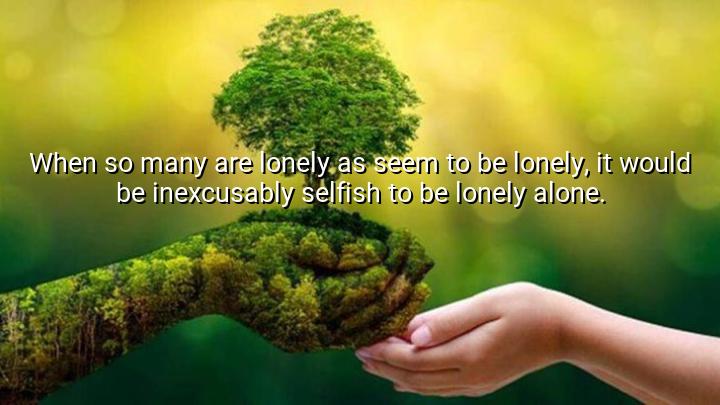




The quote "When so many are lonely as seem to be lonely, it would be inexcusably selfish to be lonely alone" by Tennessee Williams is a powerful reflection on shared human suffering, particularly the universal experience of loneliness. Williams suggests that in a world where so many people silently endure emotional isolation, choosing to retreat into one’s own lonely state without reaching out to others is a missed opportunity for connection and compassion.
Tennessee Williams, one of America’s greatest playwrights, was known for his deeply emotional and psychologically complex works such as A Streetcar Named Desire and The Glass Menagerie. His characters often grapple with themes of alienation, longing, and vulnerability, mirroring his own inner struggles. This quote is rooted in his deep understanding of emotional pain and his belief in the redemptive power of human empathy.
The idea that it is "inexcusably selfish to be lonely alone" flips our normal perception of loneliness—not as a private burden, but as something that can be shared to lessen its weight. Williams implies that by acknowledging our loneliness and being open about it, we create space for others to do the same. In doing so, we build community and reduce the collective pain that comes from believing one is alone in their feelings.
Ultimately, the quote is a call to solidarity. Rather than suffer in silence, Williams encourages us to see loneliness as a bridge to connection—a shared human condition that, when brought into the open, can foster deeper understanding, kindness, and healing among people. It’s a reminder that we are rarely as alone as we think—and that our openness might be the key to someone else’s comfort.

NPNguyen Phuong
This quote makes me think about community and shared vulnerability. It’s almost like Williams is urging us to break the illusion that loneliness is a solo experience. But do people always feel safe enough to admit they’re lonely? Maybe the real problem is that we’ve built a culture where admitting such feelings is seen as weakness. How do we begin creating spaces where loneliness can be acknowledged without shame?
LLionel
I love the emotional honesty of this quote, but it also leaves me with a question: is loneliness less about being physically alone and more about the belief that we’re alone in how we feel? If that’s the case, maybe what we need isn’t more company, but more courage to express our inner lives. What would happen if we all admitted our loneliness out loud — would the weight start to lift?
NDLe Thi Ngoc Dung
This quote feels like both an invitation and a moral responsibility. It suggests that empathy begins not just with noticing others’ pain, but with recognizing our own and using it as a bridge. But how easy is that, really? If you're feeling isolated or emotionally raw, are you even capable of being a comfort to someone else? Or does helping others sometimes become the path to helping ourselves?
KQNguyen Thị Kim Quyen
What a complex and almost paradoxical idea — that it’s selfish to suffer alone when others are suffering too. It makes me question: does shared loneliness have the power to become companionship? Could opening up about our solitude actually ease someone else’s pain as well as our own? I wonder how many potential friendships or healing moments are lost because we assume our loneliness is too personal to share.
TNThai Quyen Tran nguyen
This quote really challenges the idea of loneliness as a private burden. It makes me wonder — if so many people are experiencing the same ache, why aren’t we reaching out more? Is it pride, fear, or the illusion that we’re the only ones feeling this way? Maybe there’s a kind of quiet solidarity in loneliness that could be turned into connection, if only we were willing to be more vulnerable about it.