

To be free is to have achieved your life.
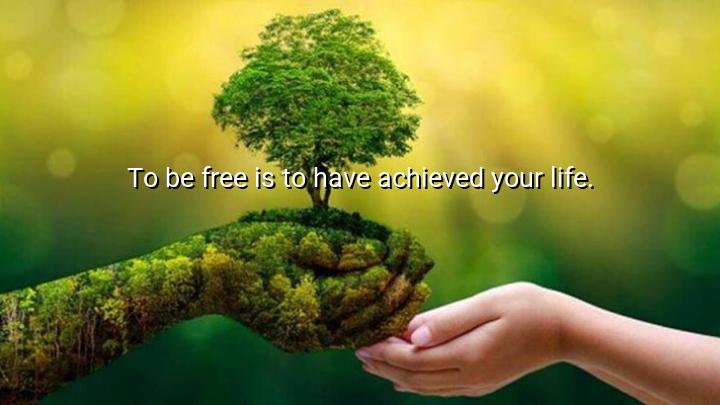




In this quote, Tennessee Williams reflects on the concept of freedom and its connection to personal fulfillment. He suggests that true freedom is not simply about external liberty or the absence of restrictions, but about having achieved and embraced the essence of one's life—one’s identity, desires, and purpose. To be free, in Williams’s view, means to have reached a point where you can live authentically, free from the constraints of societal expectations, fear, or self-doubt. It is about finding meaning and purpose, regardless of the circumstances.
Williams’s quote implies that personal achievement is not defined by external accomplishments or material success, but by the inner freedom that comes from living a life true to oneself. This achievement is the culmination of self-discovery, self-expression, and acceptance. It suggests that the ultimate measure of success is not what we possess or what we achieve in the eyes of others, but the inner peace and self-realization that come with embracing our true selves.
The origin of this quote can be traced to Williams's broader artistic and philosophical perspective. As a playwright, he often explored themes of personal struggle, identity, and the search for authenticity in his works, particularly in plays like A Streetcar Named Desire and The Glass Menagerie. His characters are frequently caught between the forces of society, desire, and repression, and their stories often center around the tension between conformity and freedom. For Williams, freedom was not just political or social, but a deeply personal journey of self-liberation.
Ultimately, Williams’s quote speaks to the idea that freedom is a deeply personal and internal state. It is achieved when an individual is able to fully embrace their life, live authentically, and free themselves from external pressures or self-imposed limitations. Freedom, in this sense, becomes the ultimate achievement, representing the moment when one has overcome personal struggles and can live life on their own terms.

AAdministratorAdministrator
Welcome, honored guests. Please leave a comment, we will respond soon