

We enter the world alone, we leave the world alone.
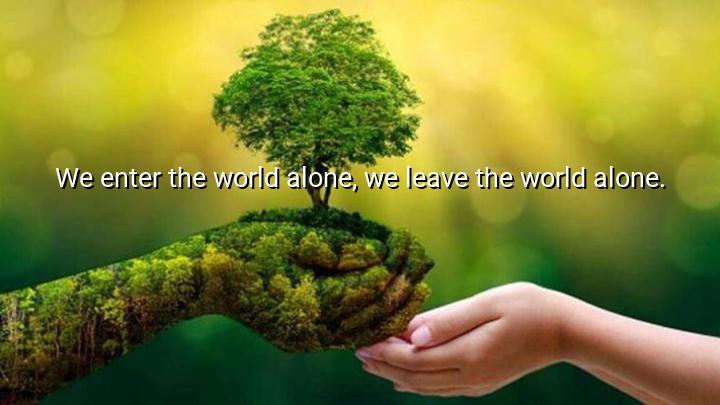




In this quote, James Anthony Froude reflects on the inherent solitude of human existence. He suggests that from the moment we enter the world—through birth—we are individually responsible for our own journey. Similarly, when we leave the world, through death, we do so alone. The quote underscores the personal nature of life and the inevitable reality that, despite our connections and relationships throughout life, our experiences of birth and death are uniquely ours.
Froude’s words also highlight the transience and inevitable isolation that define human life. While we may be surrounded by others at various points, these pivotal moments—beginning and end—are deeply personal. This can evoke a sense of existential reflection, as it emphasizes the need to confront life's journey independently, despite the importance of social relationships during our existence. It serves as a reminder of both the fragility and the individuality of human experience.
The quote can also be interpreted as a commentary on the nature of life and death. We may seek companionship, love, and connection throughout our lives, but when it comes to the most significant transitions—entering life and leaving it—we are alone. Froude suggests that self-reliance and independence are essential aspects of our existence, as no one else can fully share in or understand the deep personal experiences of these two moments.
Ultimately, Froude’s quote speaks to the impermanence and solitude inherent in the human condition. It encourages reflection on the individual journey of life, reminding us that, in the end, both the beginning and the end are deeply personal, solitary experiences. Despite the connections we make along the way, we must face these existential milestones on our own.

NTNguyen The
I feel torn by this quote. On one hand, it’s a reminder of personal responsibility—we come into the world with nothing and leave it the same way. On the other hand, it feels cold. Does it negate the idea of shared existence, of being part of something larger than ourselves? Is this a call to embrace solitude or a warning not to depend too much on others for fulfillment?
TTnguyen thi thuy tien
Reading this makes me think about the importance of self-reliance and introspection. If we’re destined to face the beginning and end alone, maybe our relationship with ourselves is the most crucial one we’ll ever have. But does that mean relationships are just temporary distractions, or are they the very things that give meaning to this solitary journey?
LVLong vo
This quote has always unsettled me. It seems to suggest that no matter how deeply we connect with others, we’re ultimately isolated. But isn’t that kind of bleak? What about those who believe in spiritual unity or the idea of legacy—something we leave behind that carries a piece of us forward? Is ‘alone’ meant physically, emotionally, or existentially? I think the interpretation really changes the tone.
BTThien Bao Tran
It’s a stark line, but one that feels emotionally honest. Still, I wonder if it oversimplifies the human experience. Sure, we enter and leave alone in a biological sense, but we’re shaped by the people around us. Love, friendship, community—those aren’t illusions. Maybe the point is that we can’t take anyone with us at the end, but does that mean we're ever truly alone?
TTNguyen Thi Thuy
I find this quote kind of melancholic, but also oddly grounding. It reminds me that no matter how surrounded we are by people, there’s a part of life—and death—that’s intensely personal. Does that make solitude a fundamental part of human existence? And if so, should we spend more time learning to be comfortable with being alone, rather than constantly chasing togetherness?