

We are all sentenced to solitary confinement inside our own skins, for life.
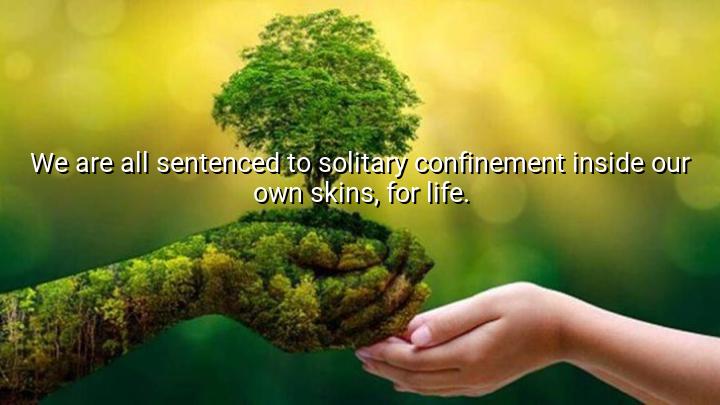




The quote "We are all sentenced to solitary confinement inside our own skins, for life" by Tennessee Williams is a striking metaphor for the inherent isolation of the human experience. Williams suggests that no matter how close we become to others, we can never fully escape the boundaries of our own consciousness. Each of us lives with our own private thoughts, emotions, and perceptions—locked within our individual bodies and minds.
Tennessee Williams, one of the most influential American playwrights of the 20th century, was known for his emotionally intense and psychologically complex works, such as A Streetcar Named Desire and The Glass Menagerie. His writings often explore themes of loneliness, alienation, and the human struggle for connection. This quote reflects his view that beneath all relationships and social roles, there remains an unbridgeable gap between ourselves and others.
The phrase "solitary confinement" evokes a sense of permanent separation, yet it’s not necessarily meant to be entirely bleak. Instead, it acknowledges a truth many people feel but rarely articulate—that we can never fully be known or understood, not even by those closest to us. This existential solitude is part of what defines us as human.
Ultimately, Williams’s quote invites us to confront the reality of selfhood with honesty. While it may seem somber, it also encourages compassion and empathy, as everyone around us is experiencing their own version of this inner confinement. Recognizing this shared solitude can, paradoxically, bring us closer together, through a deeper understanding of the human condition.

AAn
There’s something deeply philosophical about this quote. It feels like Williams is highlighting the prison of consciousness itself—our thoughts, our bodies, our subjective experience. But then I wonder, is this confinement inherently negative, or could it be a kind of sacred privacy? What if our internal solitude is also where our truest creativity, reflection, and growth come from? Is being alone in ourselves a sentence—or a form of freedom?
HNPham Thi Ha Nhi
This quote struck me as incredibly dark at first, but the more I think about it, the more it rings true. No matter how close we get to others, there’s always this sense that no one can ever really know us in totality. But maybe that’s okay? Maybe solitude is part of the deal, and connection isn’t about merging but about meeting—two separate selves finding common ground, even briefly.
NMdo ngoc mai
Reading this line feels like staring straight into the heart of human loneliness. It’s not just about being alone—it’s about the limits of ever being *fully* understood. That scares me a little. If we’re all living in our own heads, what responsibility do we have to really listen, really see each other? Maybe this quote isn’t just a statement—it’s a call to compassion despite our individual boundaries.
GLgiahuy lam
This quote makes me feel a bit unsettled. If we’re all fundamentally alone in our own skin, what does that say about love, friendship, or even community? Are those just attempts to reduce the sting of isolation, or do they offer something more real? I want to believe that shared vulnerability can soften this confinement, even if we can’t escape it. But is that just idealism, or emotional truth?
TNThuan Nguyen
I find this quote both bleak and weirdly comforting. Yes, we’re locked into our own experiences, but isn’t that also what makes each person’s inner world so rich and unique? Maybe the challenge isn’t escaping the ‘solitary confinement’ of the self, but learning how to decorate it, understand it, and make it a place worth inhabiting. Still, I wonder: can we ever truly know anyone beyond the version they show us?